
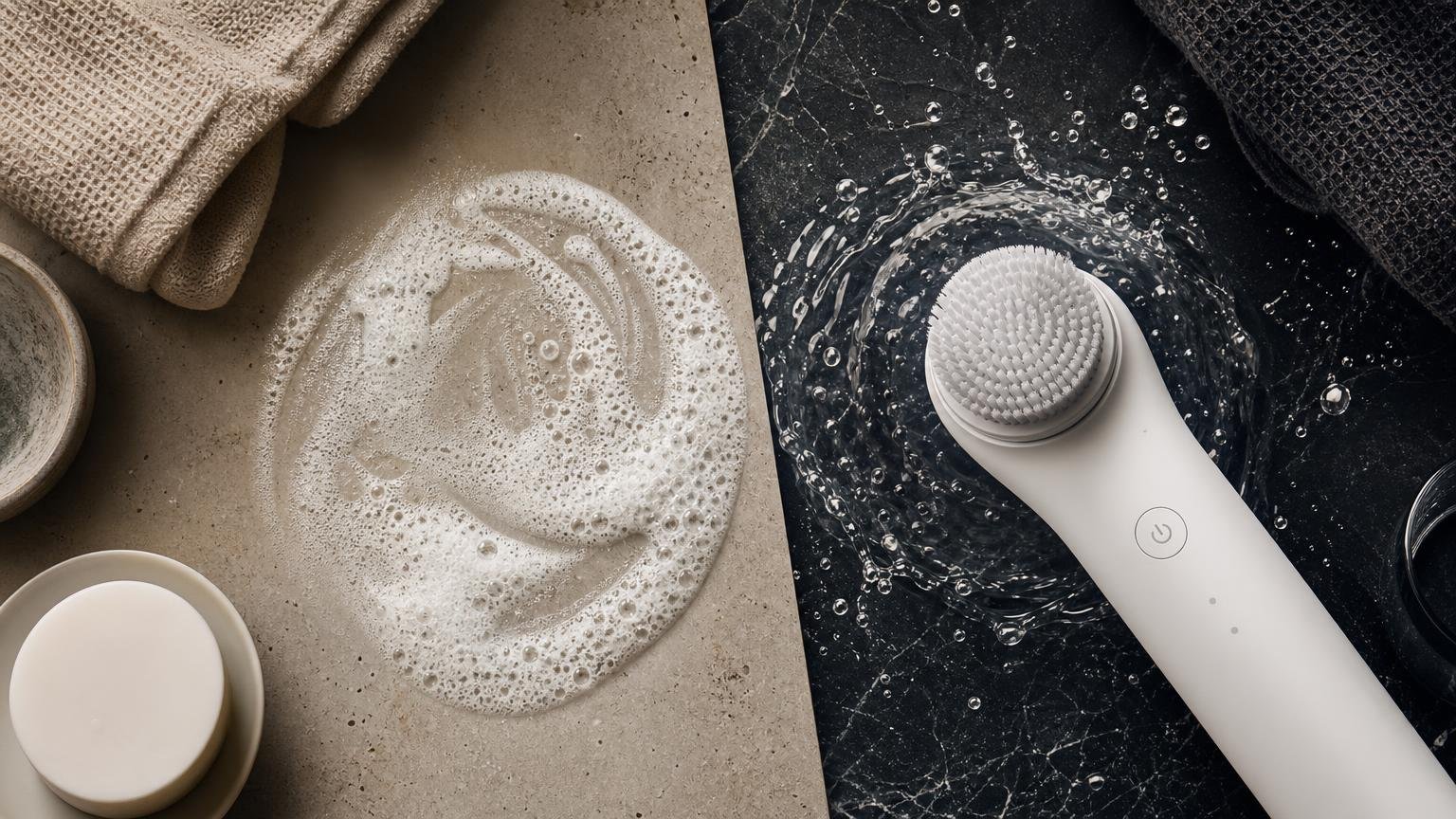
A cleaner-feeling face is not automatically a better-cleansed one.
At the sink, the uncertainty is familiar: after cleanser and rinsing, could sunscreen, foundation, oil, or airborne particles still remain? Fingers provide limited friction, while a powered or manual brush adds repeated mechanical action. That extra movement may lift more residue, particularly around the nose and hairline.
But residue removal is only half of the calculation. More friction can also increase dryness, redness, and barrier disruption, especially when paired with a harsh cleanser or excessive pressure. For stubborn sunscreen or makeup, a separate oil-based first cleanse may be more useful than a brush. The relevant comparison is therefore not hands versus bristles in isolation. It is cleansing effectiveness balanced against skin tolerance, along with cost, replacement heads, and hygiene.
Cleansing brush vs hands comes down to what each one adds: more friction, or more control.
What “cleaning better” should mean
- Better cleansing
A better method removes sunscreen, makeup, oil, and environmental residue while preserving comfort and normal barrier function. More friction or a tighter after-feel does not establish better cleaning.
- Residue removal
This is the most relevant performance outcome. It can be assessed through remaining surface material rather than foam volume, brush speed, or a polished skin feel.
- Barrier tolerance
Persistent tightness, redness, stinging, or visible abrasion indicates that cleansing intensity may exceed what the skin tolerates. Barrier effects can also be studied through water-loss and hydration measurements.
- Pore appearance
Removing oil and debris may make pores look less noticeable temporarily. Cleansing does not permanently shrink their anatomical size.
- Weakly supported benefits
Claims about detoxification, increased circulation, or improved product absorption generally lack strong evidence for cleansing brushes. Temporary redness may reflect friction, while greater absorption is not automatically desirable.
Friction, not the tool, drives the difference
Fingertips provide broad, relatively low-friction contact. Pressure can be reduced immediately around dry, tender, or textured areas. A brush adds many repeated contact points through bristles, silicone nubs, rotation, oscillation, or manual movement.
That extra action may loosen persistent sunscreen or makeup residue. It can also overwork the skin surface, especially when paired with an exfoliating cleanser. The category label alone predicts little.
Results depend more on:
- Pressure: forceful scrubbing raises friction.
- Contact time: longer cleansing increases exposure to cleanser and mechanical action.
- Frequency: daily brush use creates more cumulative contact than occasional use.
- Design: soft, flexible silicone behaves differently from dense bristles or a rotating head.
Neither fingers nor brushes “open” pores. Pores do not open and close like doors. Warm water may soften oily residue, but it does not change pore anatomy.
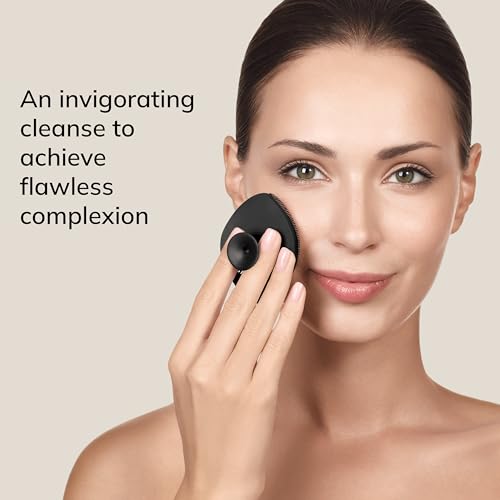
This manual brush uses extra-soft silicone nubs and a handle intended to reach facial contours. GESKE markets it for rapid cleansing and makeup-residue removal.
GESKE publishes no comparative data against fingertip cleansing. Claims about reducing blackhead appearance therefore remain marketing claims. It is not worth buying solely for deeper-cleaning promises.
- Contact surface
- Soft silicone
- Format
- Manual handle
- Model type
- 4-in-1
- Brand designation
- All skin types
The research supports caution, not a clear winner
Published evidence does not establish that cleansing brushes produce healthier skin than careful hand washing. Most findings concern immediate makeup, sunscreen, or surface-residue removal rather than hydration, barrier function, irritation, or other longer-term outcomes.
The American Academy of Dermatology commonly advises gentle cleansing with the fingertips and avoiding scrubbing, particularly when skin is easily irritated. This is practical, risk-conscious guidance, but it is not proof from controlled trials that hands remove more residue or outperform every device.
Independent studies are generally small, brief, and difficult to compare. Brush type, bristle stiffness, oscillation pattern, cleanser, pressure, frequency, and outcome measures vary substantially, so a result for one device cannot reasonably be applied to the whole category.
Manufacturer-funded trials can provide useful device-specific data, but selective comparators and short follow-up may favor visible or instrument-measured cleansing gains. Skin-friction research supports the plausibility that repeated rubbing can increase irritation or barrier disruption, yet it rarely identifies a universal threshold for actual facial use.
Removing more residue after one wash is not equivalent to improving long-term skin health. Without longer studies tracking comfort, hydration, water loss, and visible irritation, “deeper clean” remains mainly a performance claim.
When more removal effort makes sense
Water-resistant sunscreen, long-wear foundation, and heavy eye makeup can leave polymers, waxes, silicones, and pigments behind. In these cases, more contact time or a second cleanse may improve removal.
A brush adds movement, but it also adds friction. The fair comparison is not a brush against one quick hand wash. It is brush cleansing versus hand-applied double cleansing:
- Massage an oil cleanser or balm over dry skin to loosen the film.
- Add water to emulsify, then rinse.
- Follow with a mild water-based cleanser only if residue remains.
This approach targets persistent products without relying on repeated mechanical scrubbing. A soft brush used briefly may help around textured areas, but pressure should remain low. For ordinary daily cleansing, research has not established a necessary removal advantage over thorough hand cleansing.
A balm can target persistent films without adding brush friction. This formula contains 5% oat kernel oil and emulsifies with water.
The manufacturer claims it removes makeup and SPF in 30 seconds. That is not comparative evidence against brush cleansing.

Why hands are usually sufficient
For ordinary oil, sweat, and light surface residue, clean fingertips provide enough mechanical action. The cleanser does most of the work: its surfactants surround oil and suspended debris so water can carry them away. A brush may increase friction, but greater friction does not necessarily produce a more useful clean.
The American Academy of Dermatology advises applying a gentle, nonabrasive cleanser with the fingertips, using lukewarm water, and avoiding scrubbing. This approach also makes pressure easier to judge. Discomfort can be addressed immediately rather than after a timed device cycle.
A sound hand-cleansing routine is simple:
- Wash hands before touching the face.
- Massage a suitable cleanser gently over damp skin.
- Rinse thoroughly, especially around the hairline and jaw.
- Pat dry with a clean towel rather than rubbing.
Hands also remove several variables. There is no brush head to replace, dry, or disinfect, and no charging or storage requirement. For basic daily cleansing, those practical advantages matter. Unless a brush solves a specific residue problem without causing discomfort, its added cost and maintenance are often difficult to justify.
When cleansing becomes repeated exfoliation
A cleansing brush does not need an exfoliating label to exfoliate. Repeated contact removes surface cells through friction, especially when bristles are stiff, the brush is pressed firmly, or a session continues well beyond the time needed to spread and rinse cleanser. Daily or twice-daily use can compound that effect because the skin receives little time between sessions.
Pressure is easy to underestimate. Bristles that visibly bend or splay suggest more force than necessary. Motorized devices can also obscure how many passes cross the same area, particularly around the nose, chin, and cheeks.
Observable warning signs include:
- Tightness immediately after rinsing
- Stinging when applying a previously comfortable cleanser or moisturizer
- Persistent redness, flaking, or tenderness
- A smooth but unusually shiny surface
- Increasing discomfort with each brushing session
These signs do not establish a diagnosis, but they indicate that the routine may be too aggressive. A reasonable response is to stop brush use temporarily, cleanse with fingertips, use lukewarm water, and choose a mild fragrance-free cleanser. If discomfort continues, professional assessment is more useful than switching to another brush.
People with acne, eczema, rosacea, or another skin condition should seek individualized advice from a dermatologist. Added friction can aggravate visible irritation, and a brush cannot address the underlying cause.
Compare hands and a brush without changing the whole routine
-
Start with calm, intact skin
Do not run the comparison over cuts, sunburn, active irritation, or recently shaved areas. Skip abrasive scrubs throughout.
-
Hold the cleanser constant
Use the same measured amount, water temperature, cleansing time, and rinse time. Keep makeup and sunscreen use consistent.
-
Use a split-face design
Clean one side with fingertips and the other with the brush. Alternate the assigned sides each session to limit side-specific differences.
-
Keep brush exposure conservative
Use light pressure and one short pass. Begin once or twice weekly rather than daily, and clean the brush head after use.
-
Moisturize both sides equally
Apply the same moisturizer immediately afterward. Compare residue, tightness, stinging, redness, and flaking over several sessions.
-
Account for active ingredients
Retinoids, acids, vitamin C, and benzoyl peroxide can complicate the comparison. Patch-test new actives separately and pause the brush if irritation develops.
Persistent or worsening irritation warrants stopping the comparison and consulting a dermatologist.

This water-based cleanser uses decyl glucoside and coco-glucoside as its primary cleansing agents. The ingredient list contains no added fragrance.
Its straightforward formula suits a controlled comparison because the cleanser can remain unchanged. That isolates contact method more effectively than switching products.
What matters after the brush leaves the box
- Motion and contact surface
Oscillation, rotation, and vibration create different friction patterns, but speed alone does not establish better cleansing. Soft silicone may rinse more easily than dense bristles, which can retain cleanser and debris near their base.
Look forClearly stated motion settings, soft contact points, and simple pressure control.AvoidAggressive speeds or vague claims that friction “detoxes” skin or erases pores. - Cleaning and drying
The head should detach or expose all contact surfaces for rinsing. A ventilated stand matters because a brush stored wet in a closed cap is harder to dry thoroughly.
Look forAccessible seams, few residue traps, and open-air drying.AvoidDeep joints, nonremovable heads, or storage that encloses damp surfaces. - Replacement parts and recurring cost
Bristled heads commonly require periodic replacement; manufacturer schedules should be treated as cost inputs, not proof of hygiene. Check availability before buying because discontinued heads can make an otherwise functional device unusable.
Look forWidely available heads, disclosed replacement intervals, and a reasonable annual parts cost.AvoidProprietary refills with unclear supply or unsupported “antibacterial” language. - Charging and warranty terms
Battery runtime, charging method, water-resistance specifications, and warranty exclusions affect long-term value more than extra modes. A costly device is not worth the money if battery failure is excluded or replacement heads are difficult to source.
Look forCommon charging hardware, explicit water-resistance limits, and clear warranty coverage.AvoidSpecialized chargers, ambiguous shower-use claims, or short support windows.
For heavy sunscreen, the question is often the cleanser rather than the tool. Does a gentle cleanser remove sunscreen without double cleansing? covers when a second step earns its place, and how to choose a gentle cleanser covers the formula side of fingertip washing.
For most routines, clean fingertips, a mild cleanser, and a thorough rinse are the proportionate starting point. Judge the result by consistent removal without lingering tightness, stinging, redness, or flaking—not by a squeaky finish. If sunscreen or long-wear makeup remains, an oil-based first cleanse followed by a gentle water-based cleanser adds removal power without automatically adding abrasion.
A brush is optional, not an upgrade. It may suit skin that tolerates brief, low-pressure use, but published evidence does not establish a lasting advantage over hands. Keep cleanser, water temperature, and timing constant when assessing it. If irritation appears, reduce frequency or stop rather than pressing harder, extending the cycle, or choosing a harsher head. A tool that requires discomfort to seem effective is not worth keeping.
