
The easier ingredient to start is not necessarily the one supported by the stronger evidence.
A beginner may want smoother texture and softer-looking fine lines, yet abandon an active after the first stretch of dryness or irritation. Retinol has the deeper research base, supported by decades of retinoid studies, but it often requires slow acclimation. Bakuchiol is not a retinoid. Small comparative studies suggest similar cosmetic improvements with less scaling and stinging, though the evidence remains narrower and less mature.
Retinol generally suits stable routines and readers willing to start at low frequency, moisturize, and increase use gradually. Bakuchiol may be a more practical entry point for sensitivity or a routine already strained by other actives. Either product should be patch-tested on a small area before broader use; persistent irritation warrants stopping and seeking professional guidance.
Similar positioning, different chemistry
- Retinol
A vitamin A–derived cosmetic retinoid. Skin enzymes convert it first to retinaldehyde and then to retinoic acid, the form that interacts with retinoid receptors.
- Bakuchiol
A plant-derived compound commonly sourced from Psoralea corylifolia. It is not a retinoid, does not contain vitamin A, and is not converted to retinoic acid.
- “Retinol alternative”
A marketing shorthand for partly overlapping cosmetic goals, such as smoother-looking texture and more even tone. It does not establish the same mechanism, potency, dosing, outcomes, or depth of evidence.
- Comparative research
One frequently cited 12-week study reported similar changes in wrinkles and pigmentation with different application schedules, while retinol caused more scaling and stinging. A single modest trial does not establish interchangeability.
- Patch testing
Either active can irritate or trigger a reaction. A small-area patch test and gradual introduction help assess tolerance before broader use.
The evidence is asymmetric. Retinol sits within a well-studied retinoid family and established dermatology guidance, while bakuchiol has fewer human trials and less standardized use.
-
Human data carry more weight
Laboratory findings can explain plausible mechanisms, but they cannot establish visible results or tolerability in people. Small, short studies also leave more uncertainty than repeated findings across different populations.
-
Formula results stay with the formula
A study of one finished serum does not validate every product listing the same headline ingredient. Concentration, delivery system, packaging, supporting ingredients, and study design can all affect performance.
-
Retinol still requires product-level scrutiny
Broader retinoid evidence does not make every over-the-counter retinol formula equivalent. Undisclosed concentrations, unstable packaging, or exaggerated claims weaken the case for paying more.
Patch-test either active on a small area first, then introduce it gradually. Persistent irritation warrants stopping use and seeking guidance from a dermatologist.
Results depend on more than the active
Retinol has the stronger research base for fine lines, uneven tone, rough texture, and visible photoaging. Its effects depend on conversion within skin to retinoic acid. That process also helps explain dryness, flaking, and irritation.
Bakuchiol does not follow the same conversion pathway. A small 12-week comparison found similar changes in wrinkle appearance and pigmentation with 0.5% bakuchiol twice daily and 0.5% retinol nightly. Retinol caused more scaling and stinging. One study does not establish equivalence across formulas or long-term use.
The formula changes the comparison
Concentration alone is incomplete evidence. Stability, vehicle, packaging, and application frequency influence how much active remains available and how consistently a product is used.
- Retinol benefits from opaque, air-restrictive packaging and careful storage.
- Squalane or emollient bases may reduce dryness but can feel heavy on some skin.
- Bakuchiol concentration is not always disclosed, making comparisons difficult.
- Irregular use can erase the theoretical advantage of a stronger active.
Daily broad-spectrum sunscreen matters because ongoing ultraviolet exposure works against visible gains. Introduce either active gradually and patch test first. Persistent irritation warrants stopping the product and seeking professional guidance.

This water-free serum pairs an entry-level retinol concentration with an emollient squalane base. The ingredient list supports a simple, low-cost introduction to retinol.
The dropper bottle admits air during use, while retinol is sensitive to degradation. The brand advises refrigeration after opening and use within three months. That storage burden may outweigh the savings for inconsistent users.
- Retinol
- 0.2%
- Vehicle
- Squalane
- Size
- 1 fl oz
- Packaging
- Dropper bottle
Tolerability depends on the full formula
Retinol commonly causes dryness, flaking, redness, or stinging during early use, particularly with frequent application or a stronger formula. These effects can make a theoretically effective product impractical if discomfort disrupts consistent use. A lower concentration used two or three nights weekly, followed by moisturizer, is often a more measured starting point.
Bakuchiol has a gentler reputation and produced less scaling and stinging than retinol in a small comparative study. That finding is useful but limited. Bakuchiol can still cause irritation or contact reactions, and “plant-based” is not a safety standard.
The featured active is only one variable. Fragrance, essential oils, drying alcohols, exfoliating acids, preservatives, and the product vehicle can change tolerability. Applying either active after a harsh cleanser or alongside several exfoliants also raises the irritation burden. For sensitive skin, a simple fragrance-free formula may matter more than choosing the more fashionable ingredient.
Before regular use, patch test retinol or bakuchiol and introduce only one new active at a time. This makes the source of a reaction easier to identify.
Apply a small amount to a limited area on several separate days, following the product directions. Stop if marked burning, swelling, blistering, or persistent irritation occurs. A tolerated patch does not guarantee that repeated full-face use will be comfortable.
Which starting point fits the routine?
Patch-test the complete formula on a small area for several days, then introduce it gradually. Stop if persistent burning, swelling, or marked irritation develops.
What the label should reveal
- Active strength in context
A disclosed percentage helps comparison, but the vehicle, stability system, and directions also determine whether a formula suits beginners.
Look forClear concentration, complete ingredient list, and gradual-use instructions.AvoidHigh percentages presented as proof of superior results. - Protective packaging
Retinol degrades with light and air. Bakuchiol is more stable, but protective packaging still limits contamination and repeated exposure.
Look forOpaque, air-restrictive pumps or narrow dispensers.AvoidClear jars and packaging that exposes the formula repeatedly. - Fragrance and exfoliants
Fragrance adds no active benefit. AHAs, BHAs, or scrubs can make tolerance harder to assess when introduced simultaneously.
Look forFragrance-free formulas with a short supporting-ingredient list.AvoidMultiple exfoliants bundled into a beginner serum. - Specific language
“Natural retinol” is marketing shorthand, not a chemical description. Bakuchiol is not retinol and does not follow the same conversion pathway.
Look forNamed ingredients and restrained, measurable claims.AvoidPremium pricing supported mainly by vague botanical language.
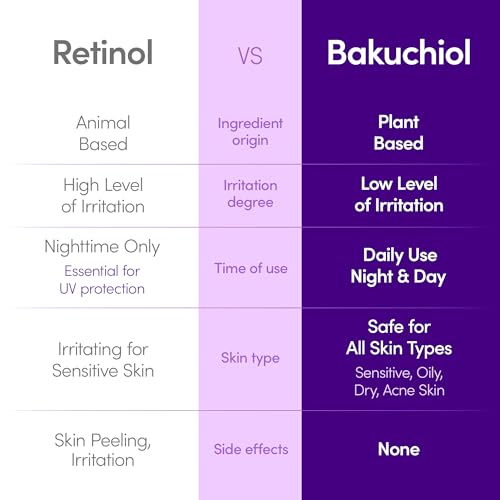
EQQUALBERRY lists bakuchiol, niacinamide, and hyaluronic acid, but the supplied listing gives no active percentages. Readers learning to interpret active ingredients on product labels should request the complete INCI list before judging fragrance or exfoliant content.
“Retinol natural alternative” overstates the relationship between the ingredients. The serum is not worth a premium based on that phrase alone. Patch-test first, then introduce it separately from other actives.
- Size
- 30 mL
- Primary active
- Bakuchiol
- Supporting actives
- Niacinamide, hyaluronic acid
- Active strength
- Not disclosed
A conservative nighttime sequence
- Stabilize the basic routine
Keep cleanser, moisturizer, and sunscreen unchanged. Introduce retinol or bakuchiol as the only new variable.
- Patch-test first
Follow the product directions on a small area for several days. A patch test can identify a reaction, but cannot guarantee facial tolerance.
- Begin one night per week
At night, cleanse and let skin dry. Apply one active as directed, then use moisturizer. Do not start retinol and bakuchiol together.
- Increase only when dryness settles
After two weeks without persistent irritation, move to two nonconsecutive nights weekly. If dryness continues, pause and restart less often rather than pushing through.
- Adjust moisturizer placement
Moisturizer may be applied before the active, after it, or both. This buffering approach can reduce direct exposure, but it does not ensure an irritation-free adjustment.
- Keep morning sunscreen fixed
Apply broad-spectrum SPF 30 or higher every morning. Sunscreen remains essential even when the active is used infrequently.
Persistent burning, swelling, or peeling warrants stopping the active and seeking guidance from a dermatologist.

A separate moisturizer can make the schedule easier to control. This cream is marketed for sensitive skin and comes in a 2.02-fluid-ounce size.
The supplied listing does not provide a current ingredient list. Its barrier-repair name alone does not establish better buffering or tolerance than a simpler moisturizer.
Combining actives without adding unnecessary irritation
Can retinol and bakuchiol be used in the same routine?
They can appear in the same formula or routine, but evidence that the combination outperforms retinol alone remains limited. For beginners, pairing them adds another variable and may increase dryness without a clear return.
Is either ingredient appropriate during pregnancy?
The American Academy of Dermatology advises avoiding retinoids, including retinol, during pregnancy. Bakuchiol is often marketed as an alternative, but pregnancy safety data are insufficient; a clinician should review the specific product and circumstances.
Can acids, benzoyl peroxide, or vitamin C be used alongside them?
AHAs, BHAs, and benzoyl peroxide can compound dryness when introduced with retinol; using them on separate nights is a more conservative approach. Vitamin C can remain in the morning routine if tolerated. Bakuchiol may be gentler, but the complete formula can still irritate.
How should a new active be patch-tested?
Apply a small amount to a limited area for several days before wider facial use, following the product directions. Stop if persistent burning, swelling, or marked irritation develops. Anyone managing acne, eczema, rosacea, or melasma should see a dermatologist for individualized guidance.
Favor retinol when depth of evidence is the priority. Favor bakuchiol when avoiding a retinoid or seeking a gentler-feeling formula is the main constraint, while recognizing that its evidence base is thinner. If cleanser, moisturizer, and daily sunscreen are not yet consistent, neither active is a useful first purchase. Start by building a stable beginner routine.
Choose a simple, clearly labeled formula over maximal strength or ambitious claims. Introduce one active at a time, patch test first, and use it consistently before judging value. A stronger product that repeatedly disrupts the routine is not worth the money.
