
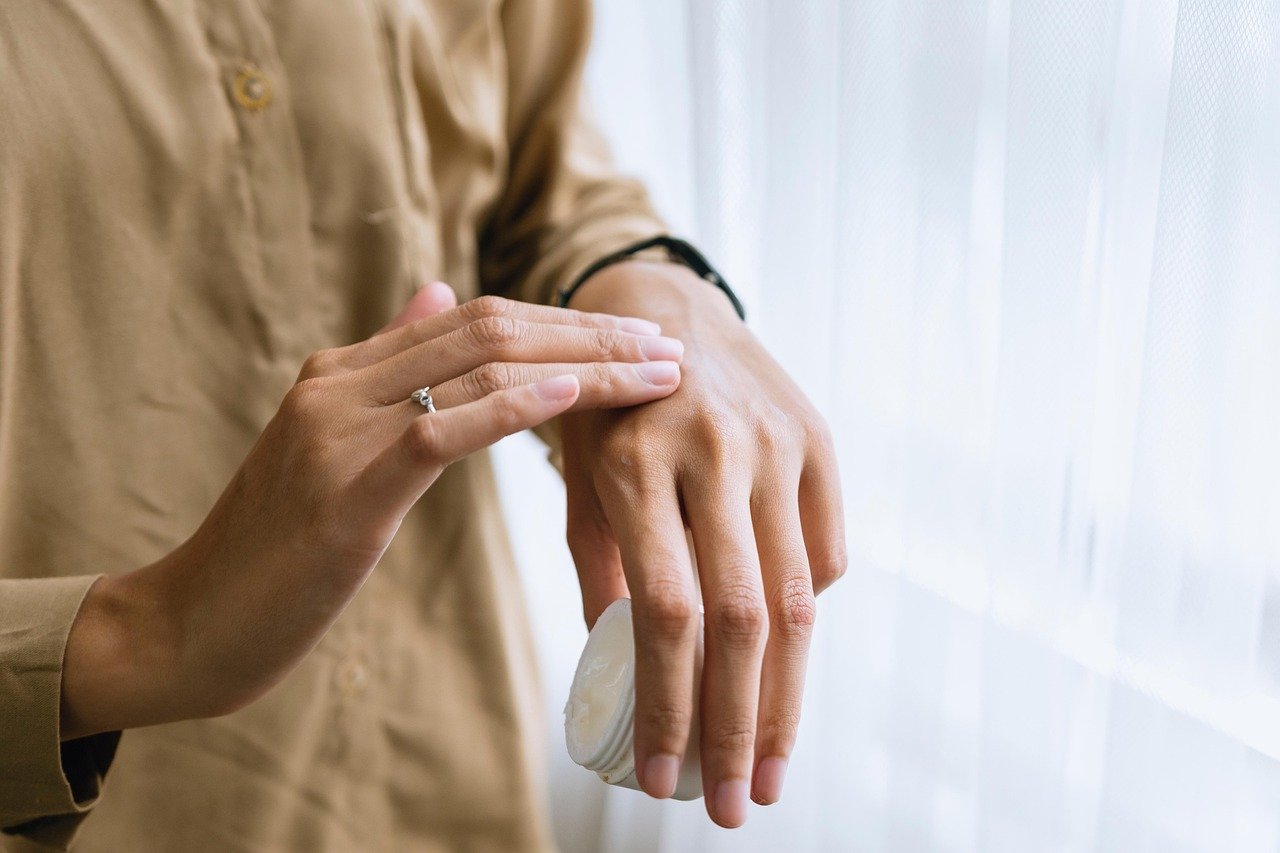
A small trial can limit the size of a bad reaction and make its likely source easier to identify.
A new retinoid applied across the face can produce widespread redness or stinging by morning. If a new cleanser or moisturizer entered the routine at the same time, the cause becomes difficult to isolate. Formula, concentration, application amount, and product combinations are all plausible variables.
Patch testing reduces that uncertainty. Exposing a small area to one product at a time may reveal an unwanted response before broader application. This is especially relevant for retinoids, AHAs, BHAs, vitamin C, and benzoyl peroxide. However, a clear patch does not guarantee safety, facial tolerance, or effectiveness. Facial skin may respond differently, and some reactions appear only after repeated exposure.
Decide whether self-testing is appropriate
Start with the product label. If it requires a manufacturer-directed allergy test—hair dye and some depilatories are common examples—follow that protocol rather than substituting a general skincare method. Do not test a leave-on product at a concentration, frequency, or site excluded by the directions.
Review the ingredient list against known personal triggers. Extra caution is warranted with retinoids, AHAs, BHAs, vitamin C, benzoyl peroxide, fragrance, and essential oils. Irritation from an active does not necessarily confirm an allergy, and a small-area test cannot reliably predict reactions after repeated full-face use.
Home testing is more reasonable when skin is intact and stable. Introduce only one new active at a time. After a significant prior reaction, deliberate re-exposure is not a sensible screening strategy; individualized medical guidance provides a safer basis for deciding whether to avoid the product.
Skip self-testing on broken, sunburned, recently shaved, or actively inflamed skin. Anyone with acne, eczema, rosacea, or another skin condition should see a dermatologist for individualized guidance.
Keep the routine stable
Patch-test results become difficult to interpret when several products change at once. Keep cleanser, moisturizer, sunscreen, and application habits consistent. If possible, use a simple skincare routine as the baseline rather than a rotating set of formulas.
Introduce one new product at a time. Do not begin a retinoid, AHA, BHA, vitamin C serum, or benzoyl peroxide during the same test window. Overlapping exposures can obscure which formula caused redness, itching, swelling, dryness, or another change.
Record enough detail to make the result reproducible:
- Product name and full ingredient list
- Date and time of each application
- Test site and approximate amount
- Application frequency
- Skin changes and when they appeared
- Other relevant exposures, such as shaving or prolonged sun
Photos taken under similar lighting may supplement the notes, but they should not replace written timing. If the routine changes unexpectedly, pause and restart later rather than drawing conclusions from a confounded test.
Choose a practical test site
No site perfectly predicts how facial skin will respond. The practical choice depends on whether easy monitoring, discretion, or similarity to the intended application area matters most.
| Site | Main advantage | Main limitation |
|---|---|---|
| Inner forearm | Easy to reach, inspect, and keep free of cosmetics | Arm skin differs from facial skin in thickness, oil production, and routine exposure |
| Behind the ear | Discreet and closer to facial skin | Harder to inspect; shampoo, hair products, sweat, and friction can confuse the result |
| Side of the jaw | More representative for products intended for the face | Reactions are more visible, and the area may already contact cleanser, sunscreen, or shaving products |
Apply only to intact skin and use the same small area for each scheduled exposure. The inner forearm is often the cleanest option for controlling variables. The jaw may provide more relevant information when facial tolerance is the main concern.
A negative result at any one site does not guarantee facial tolerance. Differences in skin structure, dose, frequency, and interactions with the rest of a routine remain important.
Apply the product under normal-use conditions
-
Cleanse the site gently
Use a mild cleanser and lukewarm water. Avoid scrubs, exfoliating tools, and vigorous rubbing, which can alter the skin barrier.
-
Let the skin dry completely
Pat dry, then wait until no surface moisture remains. Damp skin can increase the penetration of some ingredients.
-
Apply a small amount
Spread a thin layer over the chosen area. The amount should resemble ordinary use rather than a concentrated spot.
-
Follow the stated contact time
Rinse off cleansers, masks, and peels when directed. Leave-on products should remain for their intended wear period, without extending it for a stronger test.
-
Leave the area undisturbed
Do not repeatedly rub, wash, or reapply the product during the observation period. Record the application time and any visible or sensory change.
A bandage, plastic wrap, or tight dressing can trap moisture and increase ingredient penetration. This creates a harsher exposure than routine use.
Extra product and extended contact have the same problem. They may produce a reaction that says little about normal application. Occlusion should be used only when explicit product instructions or a dermatologist-directed protocol calls for it.
Repeat the test on the same site
Some reactions develop only after cumulative exposure or a delay. One uneventful application therefore provides limited evidence: it may rule out an immediate response under those conditions, but it cannot establish ongoing compatibility.
The American Academy of Dermatology describes applying a product to a small test area twice daily for seven to ten days before broader use. That schedule is a practical general framework for basic moisturizers, cleansers, and cosmetics, provided it does not exceed the product’s intended frequency.
For a cleaner comparison:
- Use the same small area for every application.
- Apply roughly the same amount each time.
- Keep contact time consistent with normal use.
- Record redness, itching, swelling, burning, or persistent dryness, including delayed changes.
Stronger actives require a more conservative interpretation. Retinoids, AHAs, BHAs, vitamin C, and benzoyl peroxide may have label directions that begin every other day or less often. The label-directed frequency takes priority over a twice-daily patch-test schedule. Extending the observation period is more informative than compressing several exposures into a few days, which can create irritation unrelated to normal use.
Record changes consistently
Check the site at consistent intervals, such as before each application and again several hours afterward. Record redness, swelling, bumps, scaling, dryness, or changes in color. Sensations also matter: note itching, warmth, tightness, stinging, or pain, along with when each began and how long it lasted.
A simple log reduces reliance on memory:
- Date, time, and application number
- Product amount and contact time
- Visible change and approximate size
- Sensation rated on the same scale each time
- Whether the response improved, persisted, or spread
Photographs can support comparison when lighting, camera distance, angle, and skin position remain consistent. A neutral background and an adjacent ruler can help show scale. Images are comparison aids, not diagnostic tools; camera processing and changing light can exaggerate or conceal redness.
Burning, persistent stinging, or increasing discomfort should not be interpreted as proof that an active ingredient is working. Marketing phrases such as “tingling means it is effective” are not supported by sensation alone. Stop the exposure and follow the product label if irritation develops; marked or worsening reactions warrant professional medical guidance.
Stop at the first sign of a reaction
Discontinue the test when a new visible change or uncomfortable sensation appears. Relevant signs include burning, persistent stinging, itching, swelling, redness, bumps, blisters, or peeling. For a leave-on product, gently rinse the area with lukewarm water. Avoid scrubbing, exfoliating, or applying another active ingredient to “neutralize” it.
Do not increase the amount, shorten the interval, cover the site, or repeat the application to confirm the result. That escalation may worsen irritation and still cannot establish whether the response reflects irritation, allergy, or another cause. Appearance and timing alone are insufficient for home diagnosis.
A mild, localized change that settles after removal can be documented and monitored. Persistent or recurring symptoms warrant routine follow-up with a dermatologist or other qualified clinician, particularly when the ingredient responsible is unclear. Bring the product name, ingredient list, exposure log, and photographs if available.
Prompt professional assessment is appropriate for rapidly spreading redness, marked swelling, blistering, skin peeling, severe pain, or involvement near the eyes or mouth. Trouble breathing, throat tightness, faintness, or widespread swelling may indicate an emergency; contact emergency services rather than waiting for the patch-test area to improve.
Expand use in controlled steps
A clear test site does not establish that the full face will tolerate the product. Facial skin may receive a larger dose, more frequent exposure, and contact with other formulas. The next trial should therefore remain limited.
Apply the product to one small facial area that reflects its intended use. A leave-on serum might be confined to part of the jaw or cheek. A cleanser can be used on one region and rinsed according to its directions. Keep cleanser, moisturizer, sunscreen, shaving habits, and other actives unchanged.
Increase only one variable
Start no more often than the label permits, and use the lower end of any recommended frequency range. Retinoids, AHAs, BHAs, vitamin C, and benzoyl peroxide warrant particular restraint. Increasing both the application area and frequency at once makes dryness, stinging, or redness harder to attribute.
Allow enough time between increases to observe the skin rather than following an arbitrary rush to daily use. If the limited area remains unchanged, expand the area first while holding frequency steady. Frequency can rise later, one step at a time. New discomfort or visible change is a reason to stop, not evidence that the product is “working.”
For acne, eczema, rosacea, melasma, or another skin condition, a dermatologist can help assess whether an active belongs in the routine.
- Retain the carton, receipt, and product directions until the facial trial is complete.
- Review return terms before opening; reactions may appear after the return window begins.
Use a simple rule: change one variable, advance one step, and stop when the skin changes. Price, “dermatologist tested” language, natural positioning, and premium packaging do not establish tolerance or efficacy. If the ingredient list and evidence do not support the claims, the product may not be worth the money.
