
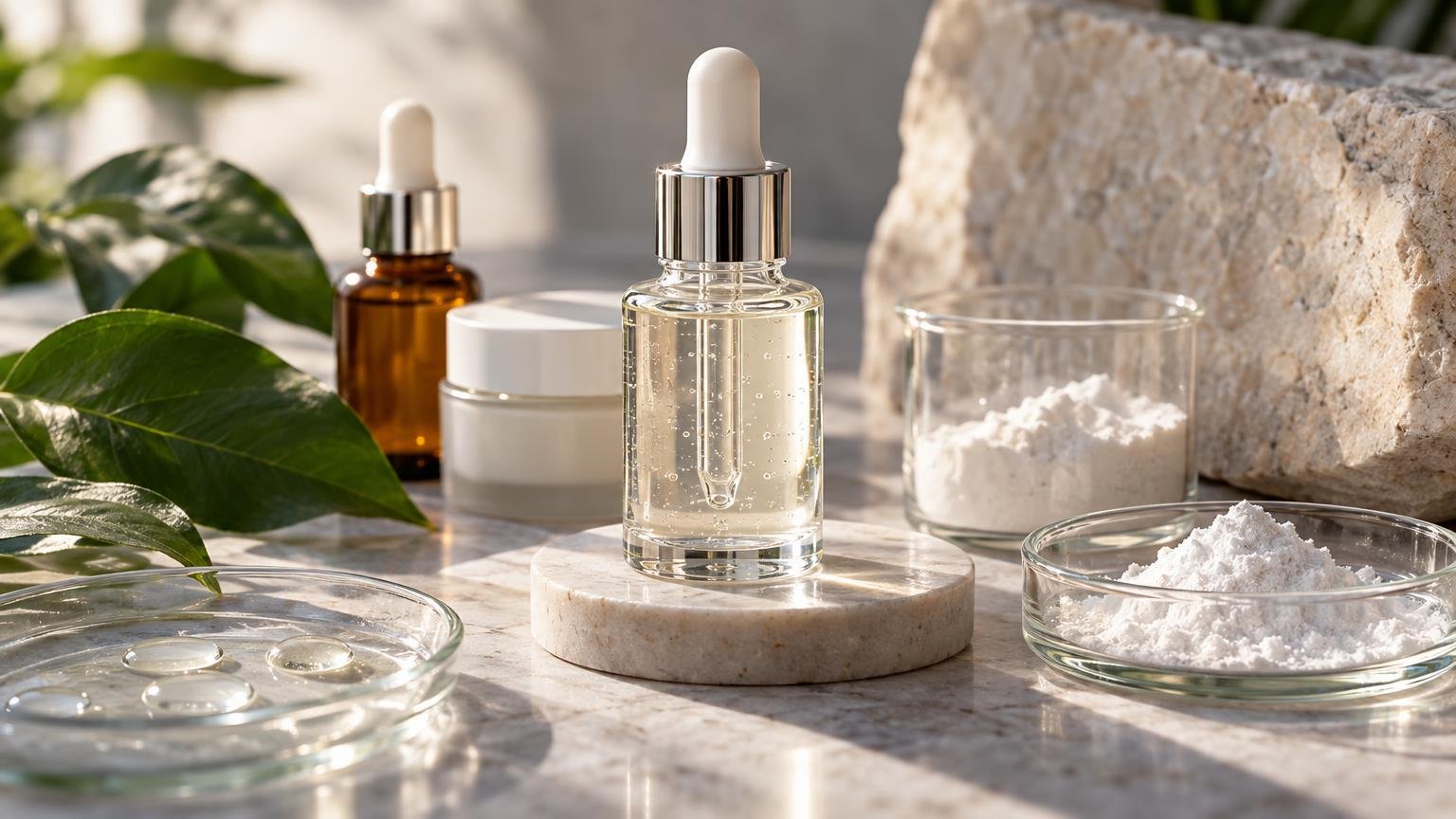
A higher niacinamide percentage reads like more strength. The research mostly tested lower doses.
A typical serum shelf now runs 5%, 10%, 12%, sometimes 20% niacinamide, each bottle implying the bigger figure works harder. The skepticism is reasonable. Much of the widely cited research on niacinamide’s effects on barrier function, oil, and uneven tone used concentrations of roughly 2% to 5%. Many bestsellers sit at double that or more.
That gap matters. The label percentage is partly a marketing variable, chosen to stand out on a shelf rather than to match a tested dose. Published data does not clearly show that 10% outperforms 5%. Higher strengths also draw more user reviews mentioning tingling or redness. The more useful question is which concentration has the strongest evidence behind it, and what the formula around that number contributes.
- 2%–5%: the range behind much of the published niacinamide research
- 10% and above: common in bestsellers, with little head-to-head data against lower strengths
- Formula, pH, and pairing with other actives can matter as much as the headline percentage
What niacinamide is understood to do
Niacinamide (also called nicotinamide) is a water-soluble form of vitamin B3. In cells it is a precursor to NAD+ and NADP+, coenzymes involved in energy metabolism and repair. That broad role explains why it appears in research on several unrelated skin concerns.
Barrier support
Niacinamide is understood to increase synthesis of ceramides and other stratum corneum lipids. In vitro and small human studies have linked this to reduced transepidermal water loss. Most of that work used concentrations around 2%.
Pigment transfer
It has been studied for reducing the transfer of melanosomes, the pigment packets, from melanocytes to surrounding skin cells. It does not appear to block melanin production itself. Trials on uneven tone commonly used 4–5%, with changes measured over eight weeks or more.
Oil and inflammatory signaling
Some studies report lower sebum excretion rates at 2%. Niacinamide is also understood to modulate inflammatory cytokines, which is why it is often studied in acne-prone skin. Anyone managing acne or rosacea should see a dermatologist rather than rely on a serum.
| Proposed pathway | Typical study concentration |
|---|---|
| Ceramide synthesis | ~2% |
| Melanosome transfer | 4–5% |
| Sebum modulation | ~2% |
The pattern is consistent. Each mechanism is plausible, and each was examined at modest doses. None of these pathways requires 10% or higher to be studied.
Matching each concern to its studied concentration
The trials most often cited for niacinamide come from a small group of researchers, several connected to Procter & Gamble. Each used a specific strength for a specific endpoint. The table pairs each concern with the concentration actually tested.
| Concern studied | Concentration tested | Commonly cited source |
|---|---|---|
| Sebum production | 2% | Draelos and colleagues |
| Acne (vs. 1% clindamycin gel) | 4% | Shalita and colleagues |
| Hyperpigmentation | 5% | Hakozaki and colleagues, Procter & Gamble |
| Melasma (vs. 4% hydroquinone) | 4% | Navarrete-Solís and colleagues |
| Barrier function and ceramides | 2% | Tanno and colleagues |
| Fine lines and texture | 5% | Bissett and colleagues, Procter & Gamble |
What the pattern shows
Every row falls between 2% and 5%. Oil and barrier outcomes were measured at the low end. Tone and aging outcomes were measured at the high end. No widely cited trial tested a serum at 10% or 20% against a 5% formula and found a clear advantage.
Two caveats apply. Several studies were small, and some were sponsored by a manufacturer. Results also came from complete formulas, so the vehicle likely contributed to the outcome.
For acne, melasma or any persistent pigment concern, a dermatologist is the right person to assess the cause and the options.
Practical reading
- A 2% to 5% product sits inside the studied range.
- A 10% product is not supported by stronger evidence, only a larger number on the label.
- Higher strengths are more often linked in user reviews to flushing or stinging.
As with any active, a patch test on the inner arm or jawline for several days before full-face use is a sensible precaution.
Why labels keep climbing past 10%
A percentage printed large on the front of a bottle is the easiest claim to compare at a glance. A 10% serum next to a 5% serum looks like a stronger product, and the price gap often reflects that perception rather than the formula. Concentration has become a shelf signal.
Some high-strength products are not meant to be used neat. Several boosters at 15–20% are designed to be mixed into a moisturizer, which dilutes the final dose back toward the studied range. Read the directions before assuming the label number reaches the skin.
What the higher-dose data shows
Published trials above 5% are sparse. The ones that exist tend to be small, short, or funded by the brand selling the product. None has shown that raising the percentage produces a proportionally better result.
Copy implying that 10% works twice as well as 5% does not hold up. Skin response to niacinamide is not understood to scale linearly, and some users report more flushing or stinging at higher strengths. Patch-test any new active on the inner arm for several days before applying it to the face.
High percentages are positioning. They are not a validated dose.
Where tolerance draws the line
Niacinamide has a reputation as a gentle active. That reputation rests largely on studies run at 2–5%. Above that range, the picture shifts toward anecdote, and the anecdotes are fairly consistent.
What users and dermatologists report
User reviews of 10% and higher serums frequently describe:
- Redness and flushing, sometimes within minutes of application
- Stinging or warmth, often on the cheeks and around the nose
- Breakouts or small bumps, which reviewers sometimes label purging
Dermatologists quoted in consumer press have offered possible explanations. One is that some formulas may contain trace nicotinic acid, which is associated with flushing. Another is that high-strength serums often pair niacinamide with acids or other actives. These are reports and proposed mechanisms, not controlled findings. Reviewers also cannot easily separate the niacinamide from the rest of the formula.
Why skin type matters
Sensitive or barrier-compromised skin may tolerate lower concentrations better. A 2–4% product is a lower-risk starting point and still sits inside the studied range. Patch testing on the inner forearm or jawline for several days before full-face use is a common precaution, particularly when layering with retinoids, vitamin C, or exfoliating acids.
Irritation may limit how much niacinamide skin can use before efficacy does. Readers with acne, rosacea, or melasma should see a dermatologist before adding a high-strength product.
The number on the bottle is only part of the dose
A 5% label describes the formula, not the skin. Several variables change what reaches the surface and how it is tolerated:
- Vehicle: a thin water serum spreads differently than a cream that holds the active against skin longer.
- pH: niacinamide is most stable near neutral; pairing it with low-pH acids may contribute to flushing in some users.
- Other actives: retinoids, exfoliating acids, and vitamin C add their own irritation load.
- Fragrance: a common co-irritant that can be mistaken for a niacinamide reaction.
- Amount applied: two pumps deliver roughly twice what one pump does.
Stacking adds up
Niacinamide now appears in toners, essences, serums, moisturizers, and sunscreens. A 4% toner, 10% serum, and 2% moisturizer will not combine into a 16% product, but daily exposure clearly exceeds what any single label suggests. Most brands do not list percentages for supporting products, so the real total is often unknown.
The practical check is the full ingredient list across the routine. If niacinamide appears in three steps, one higher-strength serum may be redundant. Anyone with acne, rosacea, or melasma should consult a dermatologist before building a multi-active routine.
Three niacinamide rules that the evidence does not support
The concern traces to older experiments using unstable ascorbic acid and high heat, where niacinamide could convert to nicotinic acid. Modern formulas at room temperature are not understood to behave this way.
The warning was repeated across forums long after formulation chemistry moved on. Pairing them may still sting on sensitive skin, which is a tolerance issue, not a chemical one.
Published trials cluster at 2–5%, and none establishes a linear dose-response or quicker visible change at 10% or above.
Bigger numbers read as stronger on a label, and stronger reads as faster.
Niacinamide does not accelerate cell turnover the way retinoids do, so the purging model does not apply. New breakouts or redness more likely signal irritation.
Retinoid vocabulary has spread to every active. Persistent breakouts or flushing warrant a lower percentage, and anyone managing acne or rosacea should see a dermatologist.
Choosing a starting percentage by skin profile
First-time or sensitive skin
A 2–5% product sits inside the range most trials used. Reported irritation clusters above 10%, so starting low leaves room to assess tolerance before adding anything else. A patch test on the inner forearm or jawline for several days remains a sensible first step.
Oily skin
Most sebum data comes from studies near 2%. Nothing in the published literature suggests that 10% moderates oil more effectively than 2%. A higher number mainly raises the odds of flushing.
Uneven tone
Pigmentation research centers around 4–5%, often over eight to twelve weeks. Results in these trials were modest and gradual. Daily sunscreen was typically part of the protocol, which complicates attributing changes to niacinamide alone.
For acne, melasma or rosacea, a dermatologist is the appropriate source of guidance.
Takeaway: a 2–5% formula covers nearly every studied use. Anything above that is a marketing choice more than an evidence-based one.
Reading a niacinamide label before paying for the number
- Stated percentage
Most published trials sit between 2% and 5%. A 10% or 20% serum often costs more per use with no trial showing a matching benefit.
Look forA disclosed 2–5% figure printed on the label.AvoidPaying a premium for a double-digit number alone. - Ingredient-list position and formula
Without a stated figure, list position is a rough proxy. Fragrance, essential oils and stacked acids add irritation risk that the niacinamide does not need.
Look forNiacinamide near the top, fragrance-free, few co-actives.AvoidEssential oils or acid blends sharing the same bottle. - Serum or booster
A 15–20% booster is designed to be diluted into another product. Applied neat, it delivers a concentration no trial has tested.
Look forClear directions on how much to mix and into what.AvoidTreating a booster as a standalone serum. - Niacinamide elsewhere in the routine
Moisturizers, sunscreens and toners frequently contain it as well. Each layer adds to the total dose on the skin.
Look forA tally of every niacinamide source across the routine.AvoidLayering three products that each carry it.
-
Choose a small test area
The inner arm or the skin behind the ear works well, since both are easy to watch and rarely irritated by other products.
-
Apply a thin layer daily for several days
Use the same amount and frequency planned for the face.
-
Watch for redness, stinging, itching or bumps
Flushing within minutes or irritation that builds over days both count.
-
Stop at the first sign of irritation
Discontinue rather than pushing through, and consider a lower percentage instead.
-
Introduce to the face gradually
Start every other day before moving to daily use.
Anyone managing acne, rosacea, melasma or eczema should see a dermatologist before adding a new active. In practice, a stated 2–5% figure, a fragrance-free base and a count of overlapping products filter out most marketing claims.
- Evidence clusters low Most published trials used 2–5%. Barrier, sebum, tone, and fine-line findings all sit inside that range.
- Higher is lightly studied Studies above 5% are sparse and often brand-funded. No trial shows a clear advantage at 10% or higher.
- Irritation tracks dose Redness, flushing, and stinging appear more often in reports tied to 10%+ formulas.
- Total exposure counts Vehicle, pH, fragrance, and layered products shape the real dose more than any single label.
For acne, melasma, or rosacea, a dermatologist is the right first stop.
Five percent as the reference point
The research supports niacinamide at modest levels. Concentrations of 2–5% carry most of the data, while higher numbers add tolerance risk without demonstrated benefit. Cumulative exposure across serums, moisturizers, and sunscreens can quietly push the total past what any one bottle states.
A practical approach: treat roughly 5% as a well-supported reference, and require a higher figure to justify itself with evidence rather than marketing. Patch test any new formula on a small area for several days, and stop if irritation appears.
