
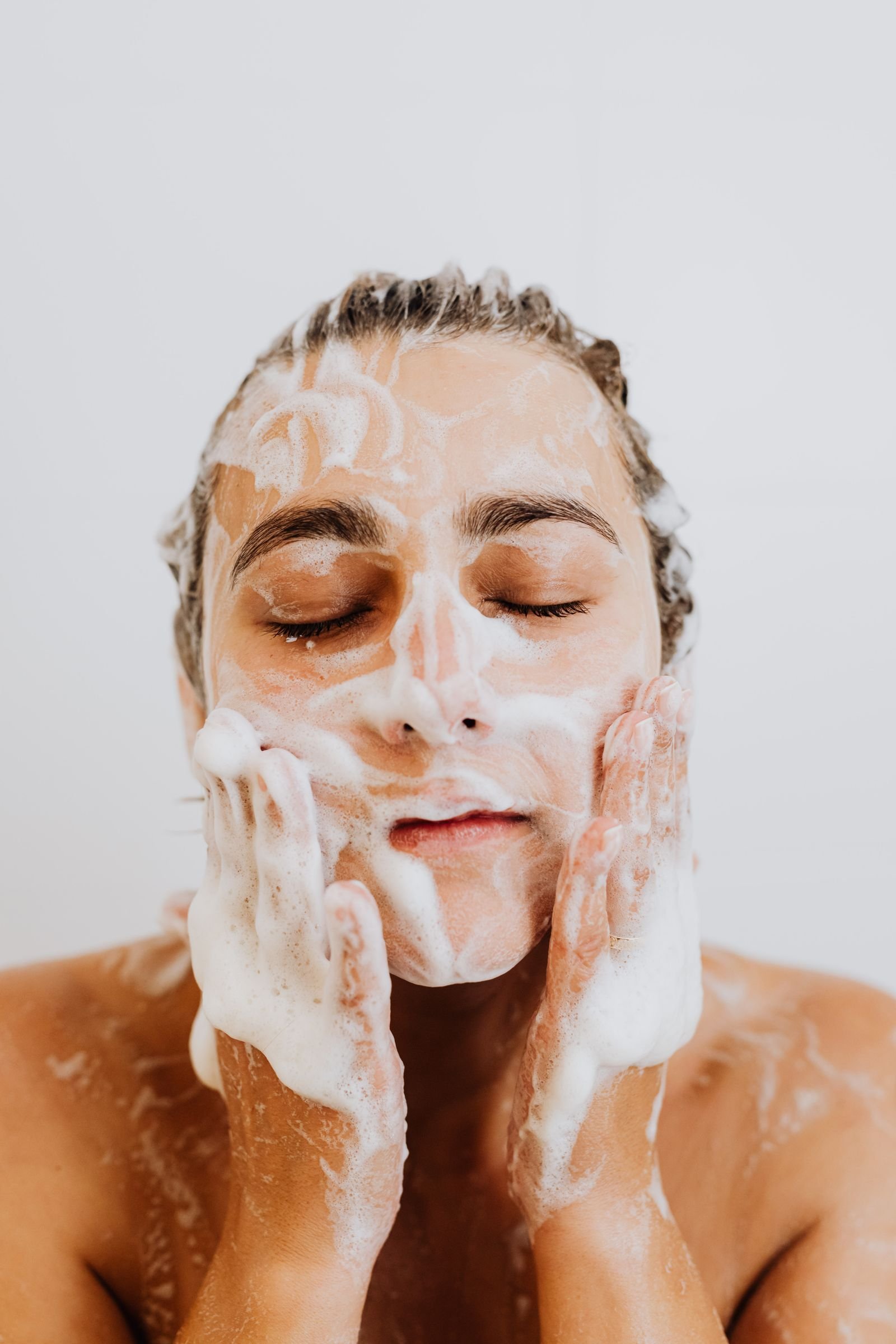
A mild cleanser depends on more than an acidic number printed on the bottle.
At the cleanser shelf, “gentle,” “soap-free,” and “pH-balanced” sound precise but reveal little. pH-balanced has no universal labeling standard, and many brands publish no measured value. A tight sensation afterward may reflect water loss, strong surfactants, frequent washing, or other formula choices; why skin can feel tight after cleansing cannot be determined from pH alone.
A facial cleanser near the skin’s mildly acidic range—often cited as roughly pH 4.5 to 6.5—is a reasonable starting point. It is not proof of mildness. Surfactant type and concentration, fragrance, wash time, water temperature, and cleansing frequency also matter. A useful comparison therefore pairs any disclosed pH with the ingredient list and consistent post-wash response. If tightness, burning, or persistent irritation continues, the cleanser is a poor fit regardless of its marketing claims.
A useful pH range for face wash
For routine facial cleansing, about pH 4.5–6 is a reasonable purchasing benchmark. The narrower pH 5–5.5 range sits close to values commonly reported for facial skin, although skin pH varies by site, age, environment, and measurement method. This range is guidance, not a medical cutoff.
What the number means
The pH scale runs from 0 to 14:
- Below 7: acidic
- 7: neutral
- Above 7: alkaline
The scale is logarithmic. A formula at pH 5 has roughly ten times the hydrogen-ion activity of one at pH 6. That chemical difference does not translate directly into ten times more or less irritation; surfactants, fragrance, cleansing time, and concentration still matter.
A cleanser above pH 7 is not automatically harsh, but traditional soaps often sit well into the alkaline range and may leave skin feeling tight. Conversely, a low-pH label does not guarantee mildness if the surfactant system is aggressive.
When comparing products, look for the finished formula’s measured pH, not the pH of one featured ingredient. Claims such as “pH balanced” have limited value when the manufacturer provides no number or test method.
What the acid mantle actually does
The acid mantle is the mildly acidic environment at the skin’s surface, created by sweat, sebum, natural moisturizing factor components, and products of normal cell metabolism. It is not a separate, impermeable coating. Its pH helps regulate enzymes involved in shedding corneocytes and organizing barrier lipids.
Acidity also influences which microorganisms can thrive on the surface. Resident bacteria contribute to this environment, while the environment helps shape the microbial community. This relationship is dynamic; a cleanser cannot meaningfully “balance the microbiome” merely because its label lists a skin-friendly pH.
Water retention depends primarily on an intact stratum corneum, organized lipids, and natural moisturizing factors. Appropriate surface acidity supports those systems indirectly. Low pH alone does not make a cleanser moisturizing.
Published measurements vary with body site, sweat, sebum, age, climate, recent washing, and measurement technique. Reported values therefore describe a range, not a universal baseline.
What washing changes—and for how long
Water alone can raise surface pH temporarily, depending partly on local tap-water chemistry. A cleanser adds surfactants, which lift oil and soil but may also remove some sebum, natural moisturizing factors, and loosely held barrier lipids. The effect depends on the finished formula rather than pH in isolation.
Several variables change the practical exposure:
- Surfactant system: Traditional soap is usually more alkaline and often more disruptive than well-formulated synthetic detergents.
- Contact time: Longer washing gives surfactants more opportunity to interact with proteins and lipids.
- Water temperature: Hot water can increase oil removal and dryness.
- Rinsing: Thorough rinsing reduces residual cleanser, although it does not immediately replace removed barrier components.
After an ordinary short wash, surface pH generally moves back toward its prior level through the skin’s buffering and acidifying processes. A brief shift is not equivalent to lasting barrier damage.
Repeated exposure to strongly alkaline cleansers, especially with long contact time or frequent washing, may prolong pH elevation and increase protein swelling or lipid removal. That supports choosing a mildly acidic, efficiently rinsing formula, but it does not establish that cleanser pH causes a skin disease. Persistent irritation or symptoms associated with acne, eczema, or rosacea warrant assessment by a dermatologist.
What low-pH evidence can—and cannot—show
Low-pH cleansers are often credited with preserving skin enzymes, lipids, and resident microbes. These mechanisms are plausible. However, cleanser studies do not consistently isolate pH from the other variables that determine mildness.
Many comparisons place alkaline soap against an acidic or near-neutral synthetic detergent bar. That design tests more than pH: soap and synthetic cleansers use different surfactant systems, interact differently with hard water, and can leave different residues. A better result for the lower-pH product therefore cannot be attributed to acidity alone.
What the evidence supports
Published dermatology and cosmetic-science literature more consistently indicates that strongly alkaline washing can raise skin-surface pH, increase swelling of the outer skin layer, and disrupt lipid-processing enzymes. The size and duration of those effects vary with contact time, rinse quality, water temperature, and baseline skin characteristics.
The case for a precise target is weaker because studies often involve:
- small or narrowly defined participant groups
- short observation periods or single washes
- forearm measurements rather than facial skin
- formulas that differ in both pH and surfactants
- laboratory endpoints instead of visible long-term outcomes
A face wash around pH 4.5–6 is a reasonable screening criterion, not proof of gentleness. A mildly acidic cleanser with aggressive surfactants or heavy fragrance may be less suitable than a near-neutral, fragrance-free formula with a milder cleansing system. Products marketed mainly around an exact pH are not necessarily worth a premium when the full formula and supporting data are unremarkable.
The formula matters more than one number
A cleanser can measure pH 5.5 and still be relatively stripping if it uses a concentrated anionic surfactant blend. Sodium lauryl sulfate, for example, generally removes oil more aggressively than milder amphoteric or nonionic systems. By contrast, a near-neutral synthetic-detergent syndet may be well tolerated when surfactants are mild, concentrations are restrained, and the product rinses cleanly.
Several variables can outweigh a favorable pH:
- Surfactant type and concentration determine much of the cleanser’s oil-removal power.
- Fragrance and aromatic extracts add exposure to potential irritants without improving cleansing.
- Solvents and exfoliating acids may increase dryness or stinging, depending on concentration and skin tolerance.
- Contact time and washing frequency increase total exposure. Longer or repeated washes can make a mild formula less forgiving.
These are among the formula factors that can make face wash sting, even when the front label emphasizes “pH balanced.” That phrase is weak evidence unless the brand discloses a measured range and the ingredient list supports a mild cleansing system.
For product comparison, pH should function as a screening metric rather than a verdict. A fragrance-free syndet near neutral may be a more rational choice than an acidic cleanser built around stronger surfactants, alcohol, or multiple exfoliants. Any cleanser containing AHAs or BHAs should be patch-tested on a small area first and introduced gradually.
Soap-free does not mean low-pH
Traditional true soap is made by reacting fats with an alkali. Facial soap bars commonly sit around pH 9–10, sometimes higher. That alkalinity distinguishes them from skin’s naturally acidic surface and helps explain why soap can leave some faces feeling tight after rinsing.
Synthetic-detergent cleansers, often called syndets, use non-soap surfactants. They can be formulated across a much wider pH range, including the mildly acidic 4.5–6 range. However, a syndet is not automatically mild: surfactant type, concentration, fragrance, and washing frequency still affect tolerability.
“Soap-free” identifies what the cleanser omits, not its measured pH. An ingredient list may reveal soap salts such as sodium palmate or sodium cocoate, but it cannot reliably establish the finished formula’s pH.
Likewise, “pH-balanced” has no single standardized consumer definition. Before paying more for that claim, look for:
- A numerical pH or stated range
- Confirmation that the value applies to the finished product
- A formula built around relatively mild surfactants
- Fragrance-free options when irritation is a concern
Without those details, “pH-balanced” is weak evidence and does not, by itself, justify a premium price.
Match the cleanser to skin behavior
- Dry or easily irritated skin
A mildly acidic cleanser may be sensible, but low foam and mild surfactants often matter more than a precise pH. Fragrance-free cream or lotion formats generally reduce unnecessary variables.
Look forpH around 4.5–6, mild surfactants, short ingredient listsAvoidTrue soap, heavy fragrance, aggressive foaming systems - Oily skin
Higher oil production does not require an alkaline cleanser. A gentle gel can remove surface oil without the tight, squeaky finish associated with harsher formulas.
Look forEffective rinsing, moderate foam, non-stripping surfactantsAvoidChoosing high pH or harsh detergents for stronger degreasing - Acid-based cleansers
AHAs and BHAs depend partly on formula pH, yet brief rinse-off contact limits exposure. A lower number does not automatically make an acid cleanser more effective or better tolerated.
Look forDisclosed acid type, concentration, pH, and clear directionsAvoidVague exfoliation claims supported only by “low-pH” marketing - Unclear pH claims
“Balanced” has no standardized numerical meaning. When a manufacturer does not disclose finished-formula pH, the surfactant system and irritation risks provide more useful evidence.
Look forSpecific formula data and a complete ingredient listAvoidPaying more for an unsupported pH-balanced label
Patch-test AHA-, BHA-, or other active cleansers on a small area, rinsing exactly as directed and repeating over several days before broader use. Stop if marked or persistent irritation develops.
Anyone managing acne, eczema, rosacea, melasma, or continuing irritation should consult a dermatologist.
How to assess a cleanser’s pH claim
- A specific, current figure
A narrow range for the finished cleanser is more useful than “pH-balanced.” Formula revisions can make old customer-service answers or screenshots obsolete.
More informativeA manufacturer specification tied to the current formulaLess informativeUndated retailer copy or unattributed pH charts - Formula context
A favorable pH does not offset aggressive surfactants, substantial fragrance, or an active-heavy formula. The ingredient list should support the gentleness claim.
More informativeMild surfactants and limited potential irritantsLess informativeTreating pH as a complete safety score - Appropriate evidence
Peer-reviewed cleanser research and guidance from reputable dermatology organizations provide context. Neither proves that one formula suits every person.
More informativeResearch that evaluates finished cleansers or relevant surfactant systemsLess informativeClaims extrapolated from ingredient pH alone - Cautious use of actives
Acids, benzoyl peroxide, and other active ingredients change the buying decision even when pH is suitable. An active cleanser should be patch-tested before broader use.
More informativeClear active concentrations and use directionsLess informativeAssuming rinse-off exposure eliminates irritation risk
Evidence quality matters because pH can vary with formulation, measurement method, temperature, and dilution. A practical review uses a source hierarchy rather than treating every reported number equally.
-
Start with the manufacturer specification
A current range for the finished product is stronger than retailer text, although it remains manufacturer-supplied rather than independent verification.
-
Check the broader literature
Peer-reviewed cleanser studies and reputable dermatology guidance help interpret whether the number is meaningful alongside surfactants and exposure.
-
Treat home strips as approximate
Strip color resolution, opaque or tinted formulas, viscosity, water quality, and dilution can shift the reading. They can flag obvious alkalinity, not establish a precise decimal value.
A pH claim without a date, method, or finished-formula reference deserves limited weight.
- Useful benchmark Favor a reliably documented finished-formula pH of 4.5–6.
- Alkaline caution Strongly alkaline soap is a poor default when dryness or tightness is a concern.
- Technique matters Use lukewarm water, keep contact brief, rinse thoroughly, and apply moisturizer afterward.
- Formula decides Surfactants, fragrance, cleansing frequency, and actual comfort remain as important as pH.
Choose evidence over the label
A cleanser within pH 4.5–6 is a reasonable starting point. However, “pH-balanced” without a current finished-formula value provides little useful evidence. Paying more for that unsupported claim is not worth it.
The practical check is how skin feels after correct use. Persistent tightness, dryness, or irritation can justify shorter contact, less frequent cleansing, more moisturizer, or a milder formula.
