
Slugging depends less on brand prestige than on what the skin can comfortably tolerate overnight.
A greasy pillowcase and a sticky morning can expose the wrong slugging match. Vaseline Original is white petrolatum alone; Aquaphor Advanced Therapy combines 41% petrolatum with humectants, emollients, and lanolin alcohol. The American Academy of Dermatology describes petrolatum as slugging’s sealing layer, so a longer ingredient list is not inherently better.
The decision turns on tolerance, finish, packaging, and value. Vaseline favors simplicity. Aquaphor may justify a premium for those who prefer its ointment texture, but not when the additions provide no clear benefit or lanolin alcohol is unwelcome. A Vaseline tube mainly adds travel convenience.
Three sensible slugging options
All three can provide an occlusive layer that limits water loss. The American Academy of Dermatology also recommends petroleum jelly for dry skin. Vaseline’s jar is the straightforward default: one ingredient and a practical size for regular use.
Formula or format?
Aquaphor adds supporting ingredients, which may improve texture but increase formula complexity. The Vaseline tube contains the same 100% white petrolatum as the jar. Portability—not better performance—is its advantage. Travel packaging may carry a per-ounce premium and is not worth it for home use.
Slugging asks very little of a product: sit on the surface overnight and slow water loss. Both of these do that, which is why the choice comes down to what else is in the tin and how it feels on a pillowcase.
The practical shortlist


What the labels actually show
Current U.S. Drug Facts labels identify 100% white petrolatum as Vaseline’s only ingredient. Aquaphor lists 41% petrolatum as its active ingredient, plus mineral oil, ceresin, lanolin alcohol, panthenol, glycerin, and bisabolol. The FDA’s OTC skin-protectant monograph recognizes petrolatum at 30% to 100% as a labeled skin-protectant active.
The ingredients perform distinct jobs. Occlusives reduce water evaporation. Humectants, including glycerin and panthenol, attract and retain water. Emollients, such as mineral oil and lanolin alcohol, smooth gaps between surface skin cells. Ceresin mainly contributes structure, while bisabolol serves as a skin-conditioning ingredient.
For readers trying to evaluate occlusive ingredients, formula length is a poor proxy for sealing strength. Aquaphor’s added ingredients may improve spreadability and conditioning, but they do not establish a tighter seal than pure petrolatum. They also introduce more potential sensitivity variables, particularly lanolin alcohol. Vaseline is the more direct choice when the goal is a simple occlusive layer; Aquaphor is more defensible when ointment texture and added humectants justify the extra complexity.
Side by side, the comparison is unusually clean. One product has a single ingredient and the other has several, and everything else follows from that.
| Top slugging pick Vaseline Original Petroleum Jelly for Dry Skin | VS | Runner-up ointment Aquaphor Advanced Therapy Healing Skin Protectant |
|---|---|---|
100% white petrolatum | Petrolatum |
41% petrolatum |
None | Added humectants |
Glycerin, panthenol |
Single ingredient | Formula profile |
Oil-wax blend |
13 oz | Listed size |
14 oz |
9.0/10 | Editorial score |
8.5/10 |
| View | View |
Vaseline is the minimal case. One ingredient means nothing to react to beyond petrolatum itself, and nothing to reformulate quietly between purchases.
Vaseline Original: straightforward occlusion
Top choice for simple, reliable moisture sealing
Vaseline Original is a 100% petrolatum ointment designed to sit over moisturizer as a moisture-sealing layer. It fits readers who want slugging without humectants, botanical extracts, or lanolin. The American Academy of Dermatology notes that petroleum jelly can help relieve dry skin, supporting its basic role as an occlusive rather than a complete moisturizer.
- Single-ingredient petrolatum formula
- No lanolin or fragrance
- 13-ounce jar lasts longer
- Strong moisture-sealing function
- Heavy, greasy skin feel
- Leaves a visible shine
- Jar requires clean handling
- Adds no humectants
Vaseline is the more defensible default for readers seeking only an occlusive top coat. Its short, lanolin-free formula limits unnecessary ingredients, while the larger jar may provide practical value through slower replacement. It is less compelling for anyone who dislikes shine, heavy residue, or dipping into a jar.
Aquaphor adds humectants and conditioning agents to the same base. That buys a lighter, more spreadable texture and costs a longer ingredient list, including lanolin alcohol.
Aquaphor: a more complex occlusive blend
A larger ointment option for intensive skin protection
Aquaphor is not pure petroleum jelly. Its NIH-hosted DailyMed label identifies petrolatum as the skin-protectant active, while mineral oil and ceresin shape the ointment base. Glycerin and panthenol support hydration; bisabolol is a conditioning ingredient. The formula suits readers who specifically prefer a softer, more spreadable ointment.
- Glycerin adds humectant support
- Mineral oil and wax modify texture
- Panthenol and bisabolol condition skin
- More spreadable than plain petrolatum
- Lanolin alcohol can cause sensitivity
- More ingredients complicate troubleshooting
- Lower petrolatum concentration than Vaseline
- Premium may not improve basic occlusion
Aquaphor’s added cost is reasonable only when its texture and supporting ingredients are specifically wanted and well tolerated. For straightforward slugging, pure petrolatum generally provides the cleaner value proposition. Anyone with a suspected lanolin reaction should stop use and consult a dermatologist.
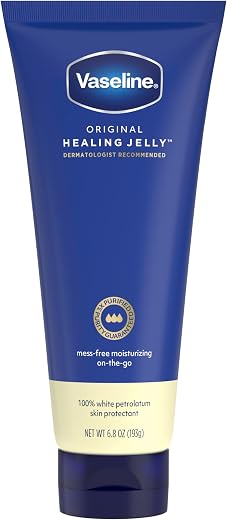
The tube is the jar’s formula in different packaging. It matters for portability and for keeping fingers out of the product, and not at all for what lands on your face.
Vaseline Original Tube: the same formula with cleaner dispensing
- Current listing shows 100% white petrolatum, matching the jar
- Squeeze dispensing limits direct contact with the remaining product
- 6.8-ounce tube is easier to pack and handle
- Smaller quantity than the large jar
- May offer poorer value per ounce
- Tube format adds little for routine home use
The tube is a sensible choice when portability, controlled dispensing, or reduced finger contact matters. For regular slugging at home, it is generally not worth paying more per ounce than the jar because the current formula is the same: 100% white petrolatum.
The restrained choice
- Jar for simplicity Choose Vaseline’s jar when formula simplicity and value matter more than cleaner dispensing.
- Aquaphor for texture Choose Aquaphor only when its added humectants, emollients, and softer texture are deliberately wanted and lanolin alcohol is tolerated.
- Tube for travel Choose Vaseline’s tube when portability and controlled dispensing outweigh likely lower value per ounce.
Two habits make slugging safer than the product choice does, and both are worth more attention than the jar-versus-tube question.
-
Apply moisturizer first
Use a familiar moisturizer on slightly damp or dry skin.
-
Add a thin layer
Spread a small amount of the occlusive over the moisturizer. More product mainly increases heaviness and transfer.
-
Let comfort set frequency
Nightly application is unnecessary if the finish feels congesting, sticky, or irritating. Reduce frequency or stop when discomfort persists.
The American Academy of Dermatology recommends testing skin-care products before broader application. Patch test Aquaphor in particular because its longer ingredient list includes lanolin alcohol.
Avoid applying an occlusive over an irritating retinoid or exfoliating acid. Occlusion can intensify discomfort. Anyone managing acne, eczema, rosacea, melasma, or another skin condition should consult a dermatologist.
- Moisturizer supplies hydration; the occlusive layer mainly reduces water loss.
- Tolerance and routine fit matter more than using an ointment every night.
For most minimalist routines, the Vaseline jar is the more defensible default. Aquaphor makes sense when its texture and added ingredients have a clear purpose. The tube is primarily a convenience purchase, not a formula upgrade.
