
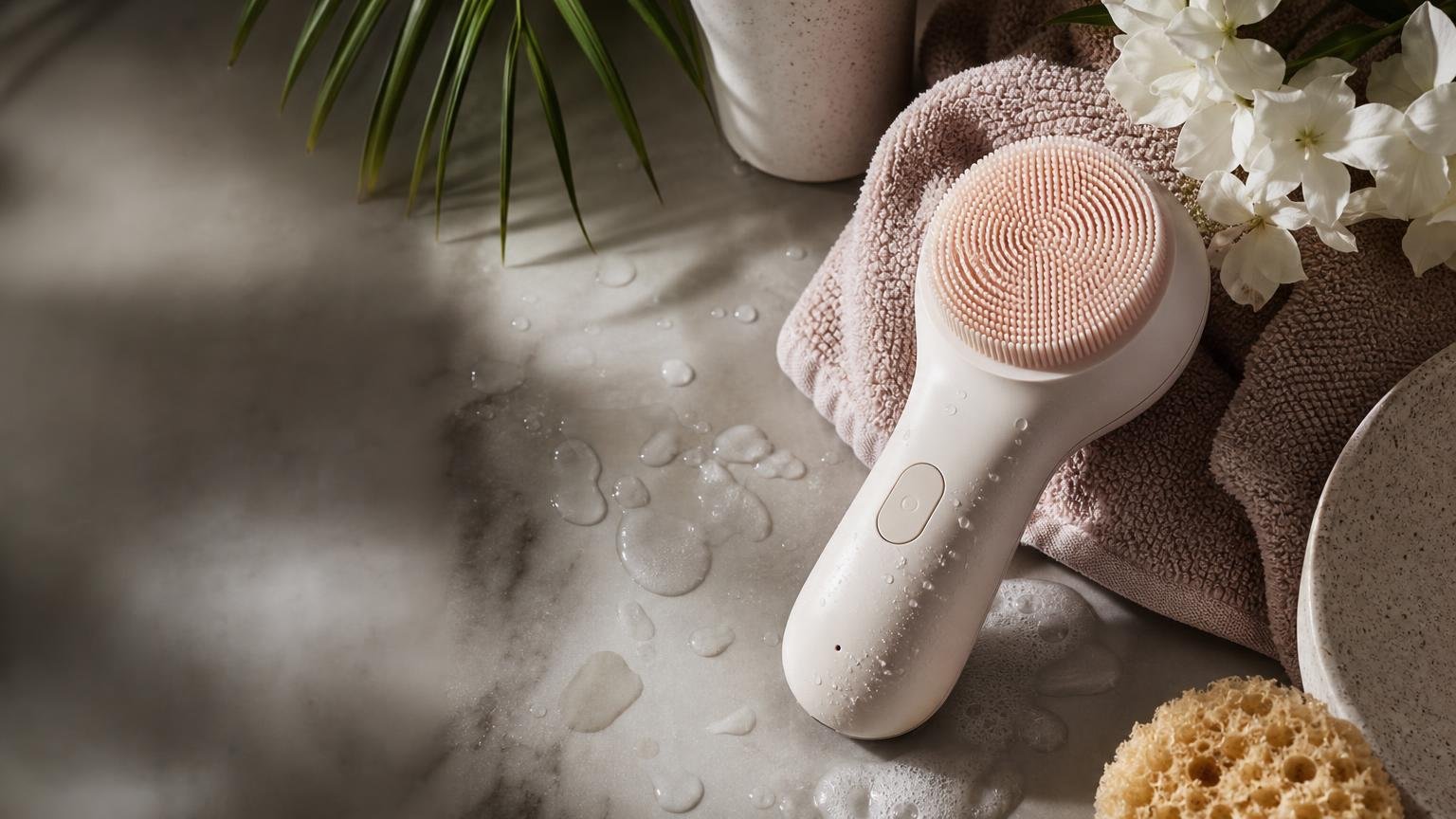
A cleansing brush adds mechanical exfoliation to a step that is often treated as friction-free.
A brush labeled for daily use may leave skin feeling polished after one wash, then tight or uncomfortable after repeated sessions. Manufacturer directions often emphasize cleansing power. Dermatology guidance is more conservative: the American Academy of Dermatology advises gentle washing and cautions against scrubbing, which can irritate the skin.
The practical approach is to start below the advertised maximum—often once or twice weekly—then assess dryness, redness, and lingering sensitivity. Frequency can increase only if the skin remains comfortable. Pressure, brush stiffness, session length, and other exfoliating products also affect tolerance. More brushing does not necessarily produce healthier-looking skin; beyond a certain point, it simply adds friction.
How often to use a facial cleansing brush is a question of tolerance, not a fixed number.
Start with a low frequency
Published research does not establish a single cleansing-brush schedule for every skin type. Manufacturer directions commonly allow daily use, but that allowance is not evidence that daily brushing provides better results or suits most users.
A cautious starting point is once or twice per week, with one short pass per session. The interval can be adjusted only after the skin remains comfortable for several uses.
Brush construction affects how conservative that schedule should be:
- Soft silicone contact points generally create less concentrated friction and may support more frequent use.
- Dense nylon bristles can produce stronger mechanical exfoliation, particularly when the head is firm or rotates continuously.
- Oscillating heads and multiple speed settings make intensity easier to control, but they do not eliminate friction.
Frequency can be increased gradually, one additional session per week at a time. Persistent tightness, stinging, redness, flaking, or tenderness indicates that the current schedule is too aggressive. Use should then be paused until the skin feels normal, followed by a return at a lower frequency.
Oiliness alone does not justify daily brushing. A standard gentle cleanser can handle routine cleansing, while the brush remains an optional tool rather than a required daily step.
Compare brush mechanics
Product categories reveal less than the way the contact surface moves across skin. A rotating head sweeps bristles in a continuous circle, while an oscillating head reverses direction over a short arc. Both create repeated passes over the same area, so speed and session length can matter as much as bristle softness.
A manual brush offers direct control but produces less consistent pressure and stroke counts. Dense or stiff bristles may create substantial friction even without a motor. By contrast, soft silicone devices use rounded, flexible nubs and generally provide milder mechanical exfoliation than conventional bristles. High speed, prolonged contact, or firm pressure can still make them irritating. “Sonic” describes movement frequency; it does not establish gentleness.
Before buying or increasing frequency, compare:
- Texture: flexible silicone, soft bristles, or dense, firm fibers
- Motion: circular rotation, short oscillation, vibration, or hand movement
- Speed settings: slower options permit more conservative use
- Pressure: a device that requires pressing to maintain contact offers limited advantage
Daily-use claims should be treated as manufacturer guidance, not a universal schedule. A costly motorized model is not worth the premium when its main benefit is extra speed that the skin cannot comfortably tolerate.
Adjust frequency for skin type
Skin type can set a cautious starting interval, but it does not determine tolerance by itself. Brush material, pressure, cleanser, climate, and other exfoliants may matter more.
- Oily skin: Start once or twice weekly. Additional oil does not justify harder pressure, longer sessions, or daily scrubbing. Friction can leave skin irritated without meaningfully controlling oil production.
- Dry skin: Start once weekly or less. A creamy, fragrance-free cleanser and a low-friction brush may reduce the tightness that can follow cleansing.
- Combination skin: Begin once weekly across the face, or restrict brushing to oilier areas if the cheeks become dry. Repeated passes over the T-zone still increase total friction.
- Sensitive skin: Consider every 7–14 days, using the softest available head and lowest setting. Persistent redness, stinging, flaking, or tenderness indicates that the interval is too short—or that the brush is unsuitable.
Skin response over the following 24 hours is more informative than the skin-type label. Change only one variable at a time. When retinoids, AHAs, BHAs, vitamin C, or benzoyl peroxide are introduced, patch-test the active separately and avoid increasing brush use during the same period.
Anyone with diagnosed or suspected acne, eczema, rosacea, or another skin condition should see a dermatologist for individualized advice before using a cleansing brush.
Increase use one session at a time
- Establish a once-weekly baseline
Use the brush once, with light pressure and the manufacturer’s shortest recommended cycle. Note immediate tightness, stinging, redness, or unusual dryness.
- Keep the routine unchanged
Maintain the same cleanser, moisturizer, brush head, speed, and session length. Changing several variables at once makes the source of a reaction difficult to identify.
- Allow several days for feedback
Skin may appear comfortable immediately but develop dryness or flaking later. Wait several days before deciding whether the current frequency is tolerable.
- Add only one session per week
If no persistent reaction appears, move from once weekly to twice weekly. Hold that schedule before considering a third session rather than increasing on consecutive weeks automatically.
- Treat the ceiling as optional
Two or three weekly sessions are a common practical limit for bristled devices. That range is not a target; once-weekly use may remain the more appropriate schedule if dryness or sensitivity increases.
When adding a retinoid, AHA, BHA, vitamin C, or benzoyl peroxide, patch-test it first and do not increase brush frequency during the same observation period.
Control pressure and contact time
Two people can use the same brush twice weekly and receive very different exposure. Pressure, speed, contact time, and the number of passes determine the practical intensity of each session. A 20-second pass on a low setting is not equivalent to several slow passes over the same area.
For a more controlled routine:
- Select the lowest effective setting, especially with a new brush head.
- Let the device move across the skin without pressing it into the face.
- Use one brief pass rather than repeatedly circling areas that feel rough.
- Skip visibly irritated, tender, or broken skin.
Cleanser choice also changes the friction load. A mild, fragrance-free liquid or cream cleanser generally creates more slip than a gritty scrub. Combining brush action with abrasive particles can make a modest schedule unnecessarily harsh. Strongly degreasing cleansers may also leave skin feeling tight even when brush contact is brief.
Extra speed modes are only useful when they support lower-intensity cleansing. Paying more for numerous settings is not worthwhile if the device lacks a genuinely gentle mode or encourages longer sessions.
Persistent tightness, stinging, redness, or flaking suggests that pressure, duration, cleanser, or frequency should be reduced.
Separate brush use from potent actives
A cleansing brush adds mechanical friction to routines already stressed by retinoids, alpha hydroxy acids (AHAs), beta hydroxy acids (BHAs), benzoyl peroxide, strong vitamin C formulas, or scrubs. Combining them in one session may increase dryness and irritation, even when each product is tolerated separately.
When introducing an active, keep brush frequency unchanged—or pause the brush—until the skin’s response is clear. When introducing the brush, leave the active schedule unchanged and begin once weekly. Alternating nights is generally more cautious than layering them; a mild, fragrance-free cleanser removes another variable.
For a directed patch test, apply the active as instructed to a small area where it is intended for use, without brushing that spot. Observe it for the period specified by the manufacturer or dermatologist. Patch testing may reveal localized sensitivity, but it cannot guarantee full-face tolerance.
Persistent burning, peeling, swelling, or marked redness is a reason to stop brush use and seek guidance from a dermatologist. Nonprescription actives should be paused until the reaction settles; prescribed products should be discussed with the prescriber before the regimen changes.
Match brush hygiene to skin feedback
-
Rinse the head after every session
Remove cleanser, makeup, and visible residue under running water. Clean the handle only as the manufacturer directs, especially when its water-resistance rating is unclear.
-
Let the head dry completely
Shake off excess water and store the brush uncovered in a ventilated area. A closed cap or damp shower shelf slows drying and can allow residue to accumulate.
-
Keep the device personal
Sharing transfers skin oils, product residue, and microorganisms between users. Cleaning does not make routine sharing a sound practice.
-
Replace worn heads promptly
Follow the manufacturer’s replacement interval, but replace sooner if bristles become bent, rough, discolored, or difficult to rinse clean. A worn head is not worth extending to save a small replacement cost.
-
Treat delayed irritation as the deciding signal
Persistent sensitivity, roughness, flaking, tightness, or new stinging from familiar products suggests that frequency or session intensity is too high. Pause brush use until skin feels settled, then restart less often rather than compensating with heavier moisturizer.
If discomfort persists after brush use stops, a dermatologist can help assess the cause.
When daily use adds little value
- A clear, repeatable benefit
Daily use may be tolerable without being necessary. Compare cleansing quality, comfort, and residue against gentle hand cleansing.
Evidence to continueA noticeable benefit that persists without extra dryness or redness.Reasons to scale backUsing the brush daily only because the instructions permit it. - Stable skin after cleansing
Reactive or compromised skin has less margin for repeated friction. Delayed tightness, stinging, flaking, or redness supports reducing frequency or stopping.
Evidence to continueSkin remains comfortable immediately and the following day.Reasons to scale backTreating irritation as evidence that the brush is working. - Value beyond marketing
Price, speed settings, and “sonic” terminology do not establish better cleansing outcomes. A costly device is not worth the money when fingertips produce comparable results with less maintenance.
Evidence to continueUseful design features and a measurable practical advantage.Reasons to scale backAssuming higher cost or vibration frequency proves superior performance. - A manageable routine
Replacement heads, drying, charging, and cleaning add effort. Complexity is justified only when the device provides a consistent advantage.
Evidence to continueHygiene and upkeep remain easy to maintain.Reasons to scale backKeeping a device that regularly complicates cleansing.
Frequency and cleanser interact. If tightness shows up even on days without the brush, why cleansers make skin feel tight helps separate the two, and how to patch test skincare lays out the test to run before adding an active to a brushing schedule.
Use the lowest effective frequency
Daily brushing is rarely necessary. If benefits remain clear and skin stays comfortable, the schedule may be reasonable; tolerance alone is not a reason to increase use.
At the first persistent sign of irritation, pause and return to gentle hand cleansing. Restart less often only after skin has settled. Persistent sensitivity or a compromised skin barrier warrants guidance from a dermatologist.
