
A gua sha gives you control; a jade roller gives you speed. Neither one lifts or sculpts.
Both tools do the same basic thing: light massage that moves a little surface fluid and makes morning puffiness look smaller for a few hours. The difference is how you get there. A roller spins across your face with even, light pressure, so it’s quick and hard to get wrong. A gua sha is a flat tool you glide at a low angle, which lets you work along the jaw, under the cheekbone and around the brow with more control, but it takes practice and plenty of oil.
Gua sha vs. jade roller isn’t really about the stone. Jade, rose quartz and steel all work the same, and steel is the practical pick: it doesn’t chip, stays cool and cleans in seconds. Choose a roller if you want a fast routine with no learning curve. Choose a gua sha if you want to target the jawline and cheekbones.
- Stainless steel won't chip and is the easiest to clean.
- A two-piece set is a cheap way to find out which tool you'll actually use.
Our two picks


| Best single tool Nuanchu Stainless Steel Heart Gua Sha Tool | VS | Best two-tool set BAIMEI Rose Quartz Roller and Gua Sha Set |
|---|---|---|
One gua sha | What you get |
One roller + one gua sha |
304 stainless steel | Material |
Rose quartz |
Won't chip | If you drop it |
Can chip or crack |
One piece; soap, water or alcohol | Cleaning |
Stone washes easily; keep the roller axle dry |
Learning gua sha with a tool that lasts | Best for |
Finding out which tool you prefer |
| View | View |
What these tools can and can't do
Buy one of these for a cool, relaxing massage and a less puffy morning face. Don’t pay extra for lifting, collagen, detox or jawline claims; that money does more as sunscreen.
Choose by routine, not by stone
- Control vs. ease
A gua sha lets you change angle and pressure and follow the jaw and cheekbone. A roller keeps pressure even and light, so there’s less to learn.
Look forGua sha for targeted work, a roller for a no-skill routine.AvoidScraping hard or going back over skin that's already red. - Speed
A roller covers the cheeks and forehead in a minute or two. Gua sha strokes are slower and need more oil.
Look forA roller if you only have two minutes.AvoidRushing gua sha strokes without enough slip. - Durability and cleaning
Steel gua sha tools like the Nuanchu and Kitsch are one piece with no joints and won’t chip. Stone rollers have a metal frame and axle that can squeak, loosen or rust, and the stone can crack if dropped.
Look forOne-piece steel, or stone with no chips.AvoidChipped stone or a wobbly roller. - Cold
Steel and stone both feel cool at first and warm up on your skin. Steel chills fastest in the fridge. The type of stone makes no difference to the result.
Look forSteel if you like a cold tool.AvoidPaying more for a particular crystal.
Use enough moisturizer or facial oil that the tool never drags, and keep the pressure light. Wash the tool with mild soap and water after each use and let it dry fully.
Stop if you bruise or stay red. If you have acne, eczema, rosacea or melasma, ask a dermatologist before starting facial massage.
Nuanchu steel gua sha: where most people should start
Durable, easy-clean steel gua sha
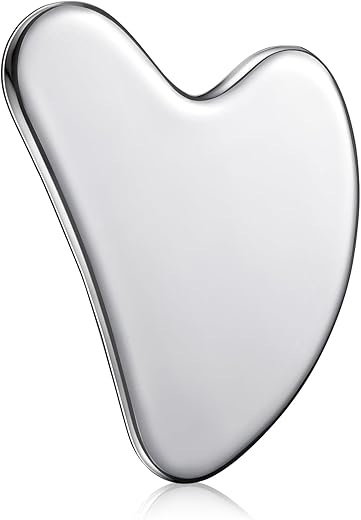
This is a single heart-shaped gua sha made from 304 stainless steel, the same alloy used in most kitchen tools and cookware. Steel is nonporous, so oil and serum wash off with soap and water, and you can wipe it with alcohol if you want to sanitize it. It won’t chip or crack if it hits the sink.
The heart shape gives you two useful edges: the broad curve fits under the cheekbone and across the forehead, and the notch at the top hugs the jawline. It’s a gua sha only, so you’ll need to learn a low angle and light pressure. If you want something that needs no technique, get a roller instead.
- One piece of nonporous steel; nothing absorbs product
- Washes clean with soap and tolerates alcohol
- Won’t chip or crack if dropped
- Notch fits the jawline, curve fits the cheeks
- Takes practice to keep the angle low
- No roller for quick, no-skill sessions
- Pressing too hard still causes redness
- Gua sha beginners
- Anyone who drops things
- Low-fuss cleaning
- People who want a roller
- Anyone set on stone
BAIMEI rose quartz set: try both tools before you commit
Roller and gua sha in one set
This kit pairs a rose quartz face roller with a matching rose quartz gua sha. It’s the cheapest way to learn which style you prefer: quick, even rolling or slower, targeted gua sha strokes.
Rose quartz feels cool at first and warms against your skin like any stone. It takes more care than steel: it can chip if dropped, and the roller’s metal frame and axle should stay mostly dry when you wash it. Store the two pieces apart so they don’t knock together.
- Two tools, so you can compare techniques
- Roller gives fast, even, light pressure
- Gua sha adds control along the jaw and cheekbones
- Low cost for two pieces
- Quartz can chip or crack if dropped
- Roller axle needs to stay mostly dry
- Stone warms up during use
- Rose quartz works no differently from steel or jade
- First-time users
- Deciding between roller and gua sha
- Light depuffing massage
- Frequent travelers
- Hard tile floors and clumsy mornings
BAIMEI jade set: the same idea in green jade

BAIMEI’s IcyMe jade kit uses the same two-piece format as the rose quartz set: a jade face roller plus a gua sha. Choose between the two on color; the stone makes no difference to what the tools do.
Like any stone set, the pieces can chip if dropped, and the roller’s frame and axle need a quick wipe rather than a soak. The set only makes sense if you’ll use both tools. If you already know you want gua sha, a single steel tool is the better buy.
- Two massage styles for a low cost
- Roller gives quick, broad passes
- Gua sha gives more control
- Poor value if one tool goes unused
- Jade works no differently from steel
- Stone can chip if dropped
- Roller axle needs care when washing
- Trying both techniques
- Budget shoppers
- Gua sha-only routines
- Anyone who wants a tool that won’t chip
PLANTIFIQUE jade set: one to give, not one to upgrade to

Jade roller and gua sha in a gift box
PLANTIFIQUE’s set is a jade roller and a jade gua sha packed in a gift box. The tools do the same job as BAIMEI’s jade pair; the higher cost goes to the presentation.
That makes it a good present for someone curious about facial massage, and a poor upgrade if you already own a roller. As with any stone set, store the pieces apart and keep the roller’s axle mostly dry when you wash it.
- Gift-ready box
- Roller and gua sha included
- Easy introduction to both techniques
- Costs more than similar jade sets
- Jade works no differently from steel
- Stone can chip if dropped
- Gifts
- Two-tool beginners
- Value shoppers
- Anyone who already owns a roller
Kitsch steel gua sha: plain steel from a known brand

Stainless steel gua sha from an established brand
Kitsch’s gua sha is a single stainless steel tool with a silver finish. It has the same practical advantages as the Nuanchu: nonporous, washable, won’t chip, and chills quickly in the fridge.
It costs more than the Nuanchu, so pick it if you’d rather buy from an established beauty-accessory brand. Either way, the result depends on light pressure and enough slip, not the logo. Chilling it is optional; the freezer makes it too cold for your skin.
- Stainless steel won’t chip or crack
- Washes clean with soap and water
- One piece, nothing to loosen
- Costs more than the Nuanchu for the same material
- No roller for quick sessions
- Takes practice to keep the angle low
- Minimal routines
- Brand-name buyers
- Easy cleaning
- Two-tool shoppers
- People who want stone
- Check the edges Run a finger around the edge. It should be smooth, with no chips or rough spots.
- Check the roller A roller should spin freely and sit tight in its frame without wobbling or squeaking.
- Keep it simple One-piece steel is the easiest tool to wash and dry.
Both tools reward a light hand. The ice roller comparison covers the coldest option, and silicone vs. bristle cleansing brushes makes the same point about friction in a cleansing tool.
Choose a gua sha if you want control. It lets you work the jawline, cheekbones and brow with a low angle and light pressure. Start with the Nuanchu stainless steel heart: it won’t chip, cleans in seconds and costs little.
Choose a jade roller if you want speed and no learning curve. It’s the easier tool for a two-minute morning depuff. Not sure which you’ll use? BAIMEI’s rose quartz set gives you both for a low cost.
Whichever side of gua sha vs. jade roller you land on, don’t pay extra for crystal type, lifting or detox claims. Both tools ease puffiness for a few hours; neither reshapes your face.
