
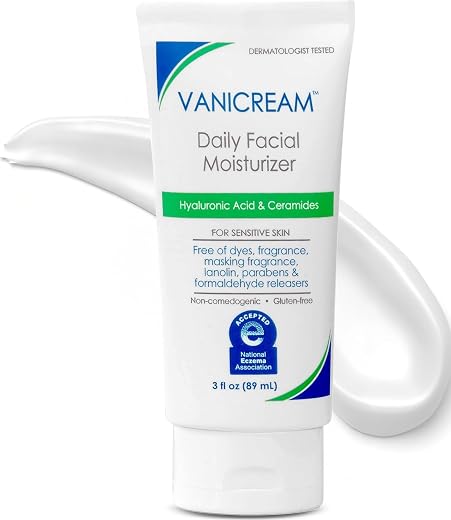
Two nearly identical front-label promises conceal a meaningful formula choice.
A shopper comparing these 3-ounce lotions encounters the same basic pitch: lightweight hydration, hyaluronic acid, ceramides, and no fragrance. The ingredient emphasis separates them. Vanicream takes the more restrained route, centering five ceramides and hyaluronic acid while excluding several commonly avoided additives. That narrower approach may suit buyers who prefer fewer functional extras.
CeraVe PM combines three ceramides and hyaluronic acid with niacinamide, plus the brand’s MVE timed-release system. This adds potential value for someone specifically seeking niacinamide, but also introduces another ingredient that some sensitive-skinned users may prefer to avoid. The manufacturer says niacinamide helps calm skin; the ingredient list alone cannot guarantee that result. Neither formula is categorically superior. A patch test remains sensible before full-face use, particularly when introducing niacinamide.
- Both are oil-free and labeled non-comedogenic by their manufacturers.
- Vanicream carries National Eczema Association acceptance; that designation does not predict individual tolerance. For eczema or another skin condition, consult a dermatologist.
Choose by formula priority, not nighttime branding
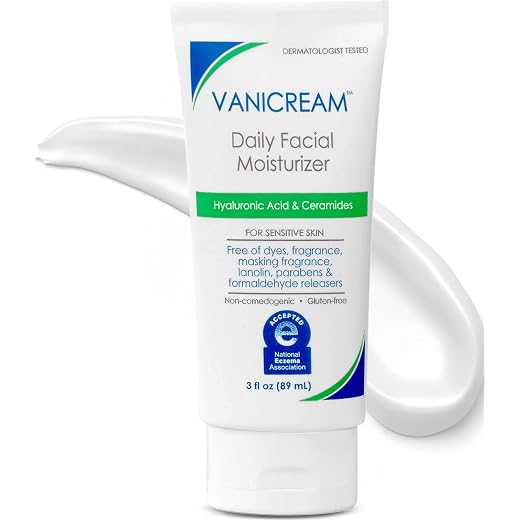


The more conservative sensitive-skin formula
Top choice for lightweight, sensitive-skin hydration
Vanicream Daily Facial Moisturizer takes a relatively restrained approach to lightweight hydration. Squalane and glycerin supply emollient and humectant support, while hyaluronic acid and five named ceramides—EOP, NG, NP, AS, and AP—round out the barrier-focused formula.
Unlike CeraVe PM, it contains no niacinamide. That distinction may matter when niacinamide has previously caused flushing or irritation, though ingredient count alone cannot predict tolerance. It fits naturally within a broader comparison of fragrance-free facial moisturizers.
- No niacinamide
- Five-ceramide blend
- Fragrance- and dye-free
- Lightweight finish
- May feel insufficient for very dry skin
- Minimalist positioning does not ensure tolerance
- Hyaluronic acid can feel tight without adequate occlusion
Assessment The formula reduces some common decision variables without becoming bare-bones. Its light texture is practical for layering, but drier skin may need a more occlusive cream on top.
Vanicream is the more defensible choice when avoiding niacinamide is the priority. Squalane, glycerin, hyaluronic acid, and five ceramides provide a coherent moisturizing base, but the lightweight vehicle may not justify the purchase for very dry skin that already requires a richer final layer. Patch testing remains sensible because a shorter-looking formula does not guarantee compatibility.
A broader barrier-support formula for day or night
Best for nighttime barrier support and calming hydration
CeraVe PM is an oil-free, fragrance-free lotion built around a multi-part moisturizing system rather than a minimalist ingredient list. It suits shoppers seeking humectants, skin-identical lipids, niacinamide, and a silicone-based moisture barrier in one product.
Despite the name, the formula is not restricted to nighttime use. “PM” is product positioning; the listed ingredients do not require darkness or evening application.
- Three ceramides and cholesterol provide a broader lipid system
- Glycerin and hyaluronic acid supply complementary humectant support
- Dimethicone helps limit moisture loss without adding oil
- Niacinamide adds a barrier-supporting, conditioning ingredient
- MVE technology is designed for gradual ingredient release
- Niacinamide creates another possible sensitivity point
- The longer formula makes reactions harder to isolate
- A silicone finish may not suit every texture preference
- The 24-hour hydration language is a manufacturer claim, not supplied comparative data
Assessment CeraVe PM offers more functional components than Vanicream, but more components do not guarantee a better match. Its value depends largely on niacinamide tolerance and preference for a more engineered texture.
CeraVe PM is the more feature-rich choice when niacinamide, several barrier lipids, two humectants, and dimethicone are all desirable. The MVE system adds a plausible delivery benefit, although the supplied evidence supports it as a brand claim rather than an independently established advantage over Vanicream. Skin that frequently disagrees with niacinamide or complex formulas may find Vanicream’s restraint more practical; patch-testing CeraVe PM before full-face use is sensible.
Two tubes of the standard Vanicream formula
- May reduce cost per ounce
- Requires fewer repeat orders
- Same formula as single tubes
- Savings depend on current pricing
- Higher upfront purchase
- Poor fit for first-time use
- Seller and packaging require scrutiny
The two-pack is reasonable for established users who expect to finish both 3-fl-oz tubes. It is not worth the money when the unit cost matches or exceeds separate tubes, or when the seller’s identity, fulfillment terms, return policy, and package condition are unclear. First-time buyers have less reason to commit before confirming that the formula suits their skin.
How the formulas were assessed
The comparison uses US manufacturer ingredient lists, product specifications, and packaging claims available at the time of review. It does not include hands-on testing or independent laboratory analysis.
Ingredients were assessed by function, concentration clues from list order, and likely effects on slip, weight, and finish. Presence alone did not establish performance.
Dispensing format, fragrance claims, and suitability across morning and evening routines were considered. Manufacturer claims were checked against what the disclosed formula reasonably supports.
Recurring patterns in attributed retailer and consumer reviews informed texture and tolerance context; isolated anecdotes carried little weight. Value reflects formula, package format, and typical per-ounce positioning rather than ingredient count.
Ingredient lists and packaging can change. The product label remains the controlling reference.
A longer list can add useful functions, but it also introduces more potential incompatibilities. The stronger buy is the formula whose texture, packaging, and ingredient profile fit the intended routine—not the one with the most marketable actives.
| Squalane-focused formula Vanicream Daily Facial Moisturizer With Ceramides | VS | Broader support blend CeraVe PM Facial Moisturizing Lotion With Niacinamide |
|---|---|---|
Glycerin + hyaluronic acid | Hydration base |
Glycerin + hyaluronic acid |
Five ceramides | Ceramide blend |
Three ceramides |
Squalane | Supporting lipids |
Cholesterol |
Emollient, restrained | Formula character |
Niacinamide + silicone |
Lightweight, emollient | Likely finish |
Silky lotion |
| View | View |
Both formulas pair humectants with ceramides, so neither relies on ceramides alone. The meaningful difference is the surrounding system.
Vanicream combines a wider ceramide set with squalane, an emollient that supplements surface lipids without adding another multifunctional active. CeraVe PM uses three ceramides alongside cholesterol, niacinamide, and dimethicone. Cholesterol complements the lipid blend, while dimethicone adds slip and reduces moisture loss; niacinamide broadens the formula but also introduces another potential compatibility variable.
Raw ceramide count does not establish better barrier support. Concentration, ratios, delivery, and the complete vehicle matter, and those details are not fully disclosed. Vanicream is the more restrained choice. CeraVe PM offers the more complex support system.
Ceramide count is not a performance score
Ceramides are lipids naturally present in the stratum corneum, the outermost skin layer. Alongside cholesterol and fatty acids, they help organize the lipid matrix that limits water loss and shields the surface from environmental exposure. In a moisturizer, added ceramides are understood to supplement this barrier-supporting mixture; “repair” would be a stronger claim than the disclosed formulas can establish.
Vanicream lists five ceramide types: EOP, NG, NP, AS, and AP. CeraVe PM lists three: NP, AP, and EOP. That numerical difference looks decisive on a label, but it does not disclose the information needed for a meaningful potency comparison:
- The concentration of each ceramide
- The ratio among ceramides, cholesterol, and fatty acids
- How effectively the lipids are dispersed and delivered
- How the complete base affects film formation and water retention
CeraVe PM also includes cholesterol and phytosphingosine, plus the brand’s claimed timed-release system. Vanicream pairs its broader ceramide list with squalane and a simpler supporting formula. Neither ingredient list proves superior barrier support. Five versus three is therefore a formulation distinction, not evidence of better performance.
Niacinamide changes the risk calculation
CeraVe PM’s clearest distinction is niacinamide. This vitamin B3 derivative is associated with supporting barrier function and improving the appearance of uneven tone. It complements the lotion’s ceramides and cholesterol, giving CeraVe PM a broader formula on paper.
That advantage should remain in proportion. The ingredient list does not disclose niacinamide’s concentration, and the formula cannot guarantee visible tone changes. Niacinamide also introduces a variable absent from Vanicream Daily Facial Moisturizer.
Some users report warmth, flushing, itching, or stinging from niacinamide products. The ingredient is generally considered well tolerated, but prior sensitivity is more relevant than its broad reputation. Anyone who has reacted to niacinamide before has a stronger reason to choose Vanicream. Its omission does not make Vanicream universally gentler, but it makes the formula more defensible when minimizing potential triggers is the priority.
Apply CeraVe PM to a small area once daily for several days before broader use. Stop if persistent flushing, burning, swelling, or itching develops. A dermatologist can assess repeated or severe reactions.
The same humectants do not create the same finish
Both formulas use glycerin and hyaluronic acid, two humectants that bind water within a cosmetic formula and at the skin’s surface. Their presence confirms a shared hydration strategy, but not equivalent performance. Ingredient lists do not disclose enough concentration data to rank either product on humectant strength.
Vanicream surrounds those humectants with squalane, glyceryl stearate, and a relatively restrained supporting base. This combination is likely to produce a lighter, more emollient slip with less of a film-like afterfeel. That may suit readers who dislike the sensation of a conventional night lotion, although finish still varies by application amount and skin type.
CeraVe PM adds dimethicone, fatty alcohols, cholesterol, and other lipids around the same core humectants. Dimethicone and the broader lipid system may leave a more coated, moisture-retentive finish. This is a formulation distinction, not proof that CeraVe keeps skin hydrated longer.
No comparable instrumental hydration measurements are provided for these two products. Claims about all-night performance or superior moisture retention therefore go beyond the available evidence.
Finish depends on the full routine
Vanicream’s squalane-rich base may leave a more noticeable sheen, especially on oilier skin or when applied generously. CeraVe PM’s dimethicone can produce a smoother slip, though attributed reviews also describe occasional tackiness or pilling. Neither pattern is universal.
Pilling often reflects interactions among moisturizer, sunscreen, primer, and foundation rather than one defective formula. Thick layers and short drying intervals increase that risk. A more controlled routine is useful:
- Apply a thin, even layer to slightly damp skin.
- Let it settle before adding the next product.
- Press or smooth gently instead of repeatedly rubbing.
- Test the complete routine before relying on it for makeup wear.
CeraVe PM may suit makeup routines that benefit from silicone slip. Vanicream may suit readers who prefer fewer formula variables, but its finish can look dewier. Both products lack sunscreen and can be used during the day beneath a separate broad-spectrum sunscreen.
Fragrance-free is not risk-free
“Fragrance-free” is useful screening information, not a safety certification. Added fragrance is a frequent source of sensitivity, so its absence may reduce one avoidable variable. However, emulsifiers, preservatives, botanical derivatives, niacinamide, and even otherwise well-tolerated moisturizers can cause irritation or allergic reactions in some people. The distinction matters when interpreting what fragrance-free labeling actually indicates.
Vanicream’s shorter, niacinamide-free approach gives highly reactive shoppers fewer prominent variables to evaluate. CeraVe PM adds niacinamide and a more complex lipid system. That does not make CeraVe PM inherently irritating, but it may be a less conservative choice for someone with a known niacinamide sensitivity.
Texture also should not be treated as a proxy for breakout potential. Occlusive ingredients reduce water loss; they are not automatically comedogenic. Dimethicone, squalane, fatty alcohols, and ceramides have different functions, and pore-clogging predictions based on isolated ingredient ratings are unreliable. Formula concentration, ingredient interactions, application amount, and individual skin response matter more.
Choosing a lighter finish is a cosmetic preference. Managing acne, eczema, rosacea, melasma, or another skin condition is a medical question; a dermatologist should guide product selection when symptoms persist or flare.
Tolerance questions before choosing
Can a fragrance-free moisturizer still cause irritation?
Yes. Fragrance is only one possible trigger. Preservatives, niacinamide, emulsifiers, or individual ingredients can still produce stinging, redness, or an allergic response.
Is Vanicream automatically safer for sensitive skin?
No formula is allergy-proof. Vanicream has fewer prominent variables and omits niacinamide, which makes it the more conservative option on paper, not a guaranteed match.
Does CeraVe PM clog pores because it contains dimethicone?
That conclusion is not supported by the ingredient alone. Dimethicone forms a water-loss-reducing film, while real-world breakout risk depends on the complete formula and the individual.
Is “non-comedogenic” a medical guarantee?
No. Testing methods and individual responses vary, and the term cannot predict every breakout. Persistent or inflammatory acne warrants dermatologist guidance.
Apply a small amount to a limited area once daily for several days before broader use. Stop if persistent burning, swelling, itching, or marked redness develops. A home patch test can reveal obvious incompatibility, but it cannot rule out allergy.
Packaging and value can change the decision
CeraVe PM’s pump offers controlled dispensing and limits repeated contact with the remaining lotion. It is convenient for consistent use, though an opaque pump makes the remaining quantity difficult to judge. Vanicream’s tube is easier to compress and cut open near the end, but dispensing can become less precise as the package empties.
Replacement frequency depends more on the amount applied than the package format. Compare labeled fluid ounces rather than bottle dimensions. A two-pack reduces ordering frequency, not product consumption, and creates more exposure to storage time or damage in transit.
Calculate unit value before buying
Divide the current total cost by the combined fluid ounces. Shipping charges should be included. A multipack is not worth the money when its cost per ounce matches or exceeds the single tube, particularly when compatibility has not been established.
Seller reliability deserves equal weight. Prefer an authorized or established retailer with clear return terms, traceable fulfillment, and intact seals. Marketplace listings can shift sellers without making that change obvious. On arrival, check the lot code, seal, package condition, odor, color, and texture; unexplained differences justify a return rather than continued use.
- Compare delivered cost per ounce, not the prominence of a “value” badge.
- Buy one unit first when formula tolerance remains uncertain.
- Store any spare unopened and within the manufacturer’s labeled shelf-life guidance.
The practical rule remains formula-first. Vanicream is the more restrained choice when avoiding niacinamide is the priority. CeraVe PM makes more sense when niacinamide and its broader lipid system provide relevant value. The Vanicream two-pack is reasonable only after tolerance, seller reliability, and a genuine unit-cost advantage are established.
