

One foams lightly and rinses clean. The other doesn't foam and leaves skin softer.
Vanicream Gentle Facial Cleanser is a 12-ingredient gel that cleans with two mild, sulfate-free surfactants. It is the better pick for oily, combination and easily irritated skin. CeraVe Hydrating Facial Cleanser is a non-foaming lotion with glycerin, three ceramides and hyaluronic acid. It is the better pick for dry skin.
Both are fragrance-free and carry the National Eczema Association Seal of Acceptance. If your skin is oily rather than sensitive, CeraVe’s Foaming cleanser is the third option worth knowing.
Vanicream vs CeraVe cleanser: what you are really choosing
The Vanicream vs CeraVe cleanser question is not about which brand is better. It is about how your face should feel after you rinse. Vanicream rinses off completely and leaves very little behind. CeraVe Hydrating cleans more softly and leaves a light, conditioned feel.
So start with your skin. If it gets shiny by midday, or you wear sunscreen and makeup most days, a clean rinse helps. But if your face feels tight within minutes of washing, a non-foaming wash usually fixes that. The American Academy of Dermatology recommends a gentle, non-abrasive, alcohol-free cleanser and lukewarm water either way.
The short list


Ingredients side by side
The labels explain almost every difference you will notice in the sink. Vanicream lists 12 ingredients. After water and glycerin come coco-glucoside and sodium cocoyl glycinate, two mild cleansing agents made from coconut and an amino acid. The rest is thickener, preservatives and a little mica and titanium dioxide for the pearly look (full list on Vanicream's page).
CeraVe Hydrating lists 24. It has no conventional foaming surfactant at all. Instead, fatty alcohols and emulsifiers such as PEG-40 stearate and polysorbate 20 lift dirt and oil. Ceramides NP, AP and EOP, cholesterol, phytosphingosine and sodium hyaluronate sit in the middle of the list (full list on CeraVe's page).
| Cleansing agents | Texture | Skin-care extras | Preservatives | Ingredients | Made for | ||
|---|---|---|---|---|---|---|---|
| Coco-glucoside, sodium cocoyl glycinate | Gel, light lather | Glycerin | Caprylyl glycol, 1,2-hexanediol | 12 | Sensitive skin | View | |
| Emulsifiers (PEG-40 stearate, polysorbate 20) | Lotion, no foam | Glycerin, 3 ceramides, cholesterol, hyaluronic acid | Phenoxyethanol, ethylhexylglycerin | 24 | Normal to dry skin | View | |
| Cocamidopropyl hydroxysultaine, sodium lauroyl sarcosinate, sodium methyl cocoyl taurate | Gel, fuller foam | Niacinamide, 3 ceramides, cholesterol, hyaluronic acid | Methylparaben, propylparaben | 24 | Normal to oily skin | View |
How each one cleans
Vanicream makes a light lather and rinses without a film. That is why it handles oil and everyday sunscreen well. Vanicream labels it soap-free, sulfate-free, pH-balanced and non-comedogenic.
CeraVe Hydrating spreads like a thin lotion and barely foams. It leaves skin feeling soft, which dry skin welcomes. Oily skin, though, can read that same feel as residue. CeraVe labels it non-comedogenic and free of added fragrance.
Neither one is built to take off water-resistant sunscreen or long-wear makeup in a single pass. On those days, use a balm or oil first. The site's guide to removing sunscreen with a cleansing balm walks through it, and how to double cleanse covers the full routine.
If your face still feels tight after washing, the cleanser may not be the only cause. Water temperature, scrubbing and how long the wash stays on all matter. See why a cleanser makes skin feel tight and what pH a face wash should be.
Two common assumptions
Foam alone doesn’t decide how stripping a wash is. The type of cleansing agent does. Vanicream foams lightly with glucoside and glycinate surfactants, which are among the milder options.
If you have avoided every foaming wash, a mild one may still suit you.
A cleanser sits on your face for under a minute before rinsing. The real benefit is that CeraVe Hydrating removes less of your skin’s own oils.
Barrier repair is your moisturizer’s job. Follow either cleanser with one.
The cleansers up close
Each card below covers what the formula does well, where it falls short, and who should skip it.


Vanicream Gentle Facial Cleanser: the short list
This is the cleanser to try first when your skin reacts to almost everything. The list is short, and it leaves out fragrance, botanical extracts, essential oils, sulfates and soap. Preservation comes from caprylyl glycol and 1,2-hexanediol rather than parabens.
Vanicream positions it for sensitive and dry skin. In practice it suits oily and combination faces too, because the light lather clears sunscreen and oil without leaving a film.
It has no ceramides or added lipids, though. Very dry skin may prefer a lotion wash. If you are curious whether it is gentle enough for daily use, see is Vanicream good for your face.
- Just 12 ingredients
- Mild, sulfate-free and soap-free
- Rinses clean with no film
- No fragrance, botanicals or essential oils
- No ceramides or added lipids
- Very dry skin may feel tight
- Not a one-step remover for heavy makeup
- Reactive or eczema-prone skin
- Oily or combination skin
- Daily sunscreen wearers
- Very dry skin that dislikes any foam
CeraVe Hydrating Facial Cleanser: no foam, softer finish
Glycerin is the second ingredient, followed by fatty alcohols and gentle emulsifiers. There is no sulfate and no soap, so it takes less oil out of your skin than a foaming wash.
Further down the list are ceramides NP, AP and EOP, cholesterol and sodium hyaluronate. CeraVe says it is made for normal to dry skin, won’t clog pores and has no added fragrance. It also carries the National Eczema Association Seal of Acceptance.
The trade-off is the finish. Oily skin can feel it hasn’t been fully cleaned, and it struggles with long-wear makeup on its own. For other matchups, see CeraVe vs Cetaphil cleanser and La Roche-Posay vs CeraVe cleanser.
- Non-foaming and very gentle
- Glycerin, ceramides and cholesterol
- No added fragrance
- Pump bottle
- Can feel like residue on oily skin
- Weak on water-resistant sunscreen
- Twice as many ingredients as Vanicream
- Dry or normal-to-dry skin
- Morning washes
- Cold, dry months
- Very oily skin
- Heavy makeup removal on its own
What about CeraVe Foaming for oily skin?
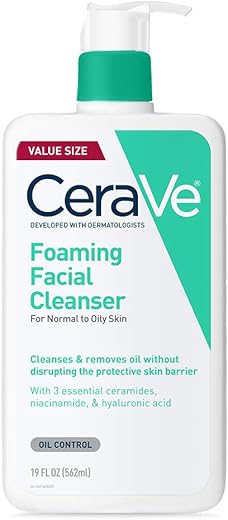
Many searches for Vanicream vs CeraVe actually mean the Foaming cleanser. It is a different product from CeraVe Hydrating. CeraVe makes it for normal to oily skin, and it foams properly with three surfactants (ingredient list).
It keeps CeraVe's three ceramides and adds niacinamide. It is preserved with parabens, which most people tolerate well. If your skin is oily rather than sensitive, Foaming will feel cleaner than either of the two above.
CeraVe Foaming Facial Cleanser: more cleaning power
A clear gel that turns into real foam. Cocamidopropyl hydroxysultaine, sodium lauroyl sarcosinate and sodium methyl cocoyl taurate do the cleaning, and none of them is a sulfate.
Niacinamide, ceramides NP, AP and EOP, and cholesterol round out the formula. No fragrance appears on the ingredient list.
It is too much for dry or very sensitive skin. Stick to Vanicream or CeraVe Hydrating there.
- Clears oil and sunscreen well
- Niacinamide and ceramides
- Sulfate-free
- Can tighten dry skin
- Contains parabens, which some people avoid
- Oily skin
- Humid climates
- Post-workout washes
- Dry or very sensitive skin
Match the cleanser to your skin
- Sensitive or eczema-prone skin
Vanicream. It has the shortest ingredient list and the fewest likely triggers. CeraVe Hydrating is a close second if your skin is also dry.
Better fitVanicream Gentle Facial CleanserSkipSwitching several products at once. - Dry or normal-to-dry skin
CeraVe Hydrating. It doesn’t foam, so your face shouldn’t feel tight afterward.
Better fitCeraVe Hydrating Facial CleanserSkipFoaming washes twice a day. - Oily or combination skin
Vanicream if you are also sensitive. CeraVe Foaming if you are not.
Better fitA light lather that rinses cleanSkipLotion cleansers that leave a film. - Daily sunscreen and makeup
Use a balm or oil first on heavy days, then either cleanser. Read how to choose a gentle cleanser for more.
Better fitA two-step routine on heavy daysSkipExpecting one wash to remove everything.
Frequently asked questions
Which is better, Vanicream or CeraVe cleanser?
Neither is better for everyone. Vanicream suits sensitive, oily and combination skin. CeraVe Hydrating suits dry skin. CeraVe Foaming suits oily skin that isn’t sensitive.
Is Vanicream or CeraVe better for eczema?
Both carry the National Eczema Association Seal of Acceptance. Vanicream has the shorter list, so it is the simpler first try. Ask your dermatologist if your skin flares with every cleanser.
Does CeraVe Hydrating Cleanser remove makeup?
It removes light makeup and everyday sunscreen. For long-wear makeup or water-resistant sunscreen, use a cleansing balm or oil first.
Is Vanicream cleanser good for acne-prone skin?
It is labeled non-comedogenic and has very few ingredients, so it pairs well with acne treatments that already dry the skin.
Is CeraVe Foaming the same as CeraVe Hydrating?
No. Foaming is made for normal to oily skin and cleans more strongly. Hydrating is a non-foaming lotion for normal to dry skin.
Can I use both cleansers?
Yes. Some people use CeraVe Hydrating in the morning and Vanicream or CeraVe Foaming at night, when there is sunscreen to remove.
Choose Vanicream if your skin is sensitive, oily or combination. Choose CeraVe Hydrating if your skin is dry and foaming washes leave it tight. Choose CeraVe Foaming if your skin is oily but not sensitive.
The Vanicream vs CeraVe cleanser choice comes down to how your skin feels after you rinse. Vanicream gives the cleanest rinse from the shortest list. CeraVe Hydrating gives the softest finish for dry skin.
Whichever you pick, wash with lukewarm water, follow with moisturizer, and give it a few weeks before you judge it. Comparing Vanicream with Cetaphil instead? See Vanicream vs Cetaphil cleanser.
