
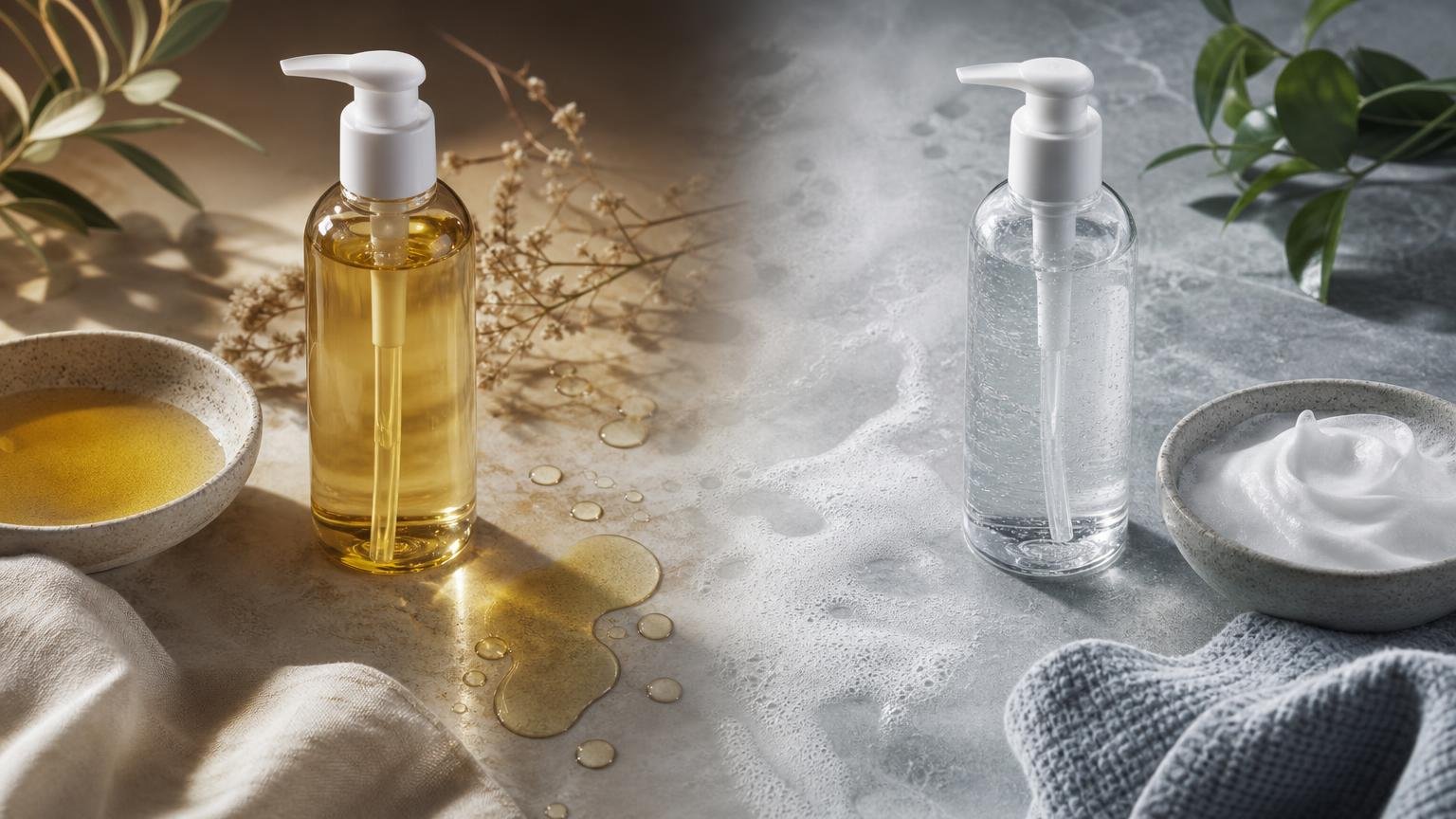
Double cleanse only on nights you wore water-resistant sunscreen or long-wear makeup: oil or balm first, then a short wash with a gentle cleanser.
Here’s how to double cleanse without over-washing: massage a cleansing oil or balm onto dry skin for 30 seconds to a minute, add a splash of water until it turns milky and rinse, then wash for 20 to 30 seconds with a mild, low-foam cleanser in lukewarm water. Two short, gentle steps, not two thorough scrubs.
The first step dissolves what water alone can’t: water-resistant sunscreen, long-wear foundation, waterproof mascara. The second clears the leftover oil and whatever the first step loosened. On nights you wore a light sunscreen and no makeup, one wash is enough. Doing both steps every night anyway is how double cleansing turns into dry, tight, stinging skin.
- Tight skin after rinsing means you stripped oil and water, not that you got it cleaner.
Decide if tonight needs two washes
Two washes aren't automatically cleaner than one good one. One wash with the right cleanser gets most faces clean, and a second step is worth it only when something on your skin is built to resist water.
Double cleanse on nights you wore:
- Water-resistant sunscreen, especially if you reapplied during the day
- Long-wear foundation, concealer or setting spray
- Waterproof mascara or eyeliner
- Heavy cream makeup or stage paint
A light moisturizer, an everyday sunscreen or a bit of regular mascara comes off with one gentle wash. Quick test: after one wash, swipe a damp white cotton pad along your hairline and jaw. If it comes away clean, you're done.
Let your skin tell you when to stop
Right after rinsing, your skin should feel clean but not coated, and not tight, hot or itchy. Check again about 10 minutes later, before moisturizer. If it feels tight or stings, something is too strong: the cleanser, the water temperature, how long you washed, or how often you double cleanse.
Fix it in this order: switch to lukewarm water, cut the second wash to 20 seconds, use less product, then drop to one wash on light days. That lines up with the American Academy of Dermatology's basic advice: a gentle cleanser, lukewarm water, fingertips and no scrubbing.
Pick a first cleanser that matches the film
The first cleanser does the heavy lifting on sunscreen and makeup so the second one can be gentle. Choose it by format, not by the skin type on the label: oil or balm for water-resistant sunscreen and long-wear makeup, micellar water for light makeup.
| Format | Removal profile | Friction and rinse behavior |
|---|---|---|
| Cleansing oil | Suited to water-resistant sunscreen, long-wear base, and oil-soluble pigments. | Spreads with little rubbing. An emulsifier allows water to turn the oil milky and rinse it away. |
| Balm | Removes similar layers, with waxes providing a thicker texture and more control around the eyes. | Usually low-friction, but wax-heavy formulas may require a longer rinse. |
| Micellar water | Efficient for light makeup and surface debris. Less reliable for persistent waterproof films. | Repeated cotton-pad passes increase friction. A water rinse can reduce surfactant residue. |
Pick an oil or balm that turns milky when you add water. That milkiness means it contains an emulsifier and will rinse away instead of leaving a greasy film for your second cleanser to fight. Simple mineral oil formulas work fine; plant oils aren't gentler by default.
Skip fragrance and long botanical blends: they don't help remove makeup, and they give your skin more to react to. "Noncomedogenic" has no set testing standard, so it can't promise you won't break out. A pricier balm isn't worth it if it rinses off the same way a drugstore one does.
How to do the first cleanse
- Start dry
Dry hands, dry face. Water added too early stops an oil or balm from dissolving sunscreen and makeup.
- Massage briefly
Use your fingertips in light circles for 30 seconds to a minute, going longer only over heavy makeup. You’re dissolving the film, not scrubbing.
- Emulsify
Wet your fingertips and keep massaging until the oil turns milky. Add water a little at a time; that’s what lets it rinse clean instead of leaving a greasy layer.
- For micellar water, press, then sweep
Soak a soft cotton pad, hold it on stubborn makeup for several seconds, then sweep once with light pressure. Repeated wiping just adds friction.
- Rinse, then go to step two
Rinse with lukewarm water and move on to your second cleanser. Repeating the first step is rarely needed.
Waterproof mascara comes off more gently with a dedicated eye makeup remover held on the lashes for a few seconds than with a balm rubbed over the lids.
Keep the second cleanser mild
The second cleanser is a gentle water-based wash. It lifts the emulsified oil and the last traces of sunscreen. It doesn't need to remove makeup again, and it shouldn't leave you squeaky.
| Format | Typical cleansing profile | What to check |
|---|---|---|
| Gel | Often light to moderate | Mild surfactants; no added fragrance; little tightness after rinsing |
| Cream | Usually lower-foam and emollient | Whether it rinses clean rather than leaving another film |
| Foaming | Highly formula-dependent | Surfactant blend and after-feel, not foam volume |
Ignore the foam. Mild surfactants can lather a lot and harsh ones can barely lather. What matters is how your skin feels 10 minutes after rinsing: comfortable is right, while tight or stinging means it's too strong for a second wash.
"Clean" on a label tells you nothing; it has no legal definition for US cosmetics. "Fragrance-free" and a short ingredient list tell you more.
Don't pay extra for actives in a product you rinse off after 30 seconds. Acids, vitamin C and botanical extracts get very little time on your skin in a cleanser, so a plain, inexpensive wash does the second step just as well.
How to do the second cleanse
-
Use lukewarm water
Neutral, not hot. Hot water strips more of your skin’s own oils.
-
Use a small amount
Just enough to cover your face in a thin layer. More product only means more rinsing.
-
Fingertips only
No washcloth, brush or textured pad. The first cleanse already did the hard part.
-
Keep it to 20 to 30 seconds
Cover your hairline, jaw and the sides of your nose, then stop.
-
Rinse well and pat dry
Rinse until nothing feels slippery, then press a soft towel to your face instead of rubbing.
-
Check after a few minutes
Tight, stinging, red or squeaky means something is too much: the cleanser, the time, or the number of nights you double cleanse.
Double cleanse at night only, then moisturize fast
Double cleansing is an evening step. Do it on nights you wore water-resistant sunscreen or long-wear makeup, and use one gentle wash on the rest. If you wear full makeup every day, that can mean every night. If you mostly wear an everyday sunscreen, it may be only a couple of nights a week.
Mornings need less. Dry or reactive skin can rinse with lukewarm water; oily skin can use one gentle wash. Don't double cleanse in the morning: there's no makeup or sunscreen on your face to remove.
Moisturize within a few minutes, while your skin is still slightly damp, so the moisturizer traps that water before it evaporates. Look for humectants like glycerin plus emollients or occlusives like ceramides, squalane, petrolatum or dimethicone.
If your skin stays tight or starts to flake, double cleanse only on your heaviest makeup nights and switch to a gentler second cleanser, such as a cream or lotion wash.
Fix problems one change at a time
Change one thing, then give it several days. If you swap the cleanser, the water temperature and the frequency all at once, you won't know which change fixed the problem.
| Warning sign | Conservative adjustment |
|---|---|
| Tightness after rinsing | Shorten the second cleanse or omit it on low-residue days. Keep water lukewarm. |
| Flaking | Reduce double-cleansing frequency and pause exfoliating cleansers. Apply a plain moisturizer promptly. |
| Stinging | Stop the newest or most active product first. Avoid scrubs, hot water, and fragranced formulas while reassessing. |
| Lingering residue | Extend first-cleanser emulsification slightly before adding more product or rubbing harder. Check whether the film is the cleanser’s intended finish. |
Cleansers with AHAs, BHAs, benzoyl peroxide, retinoids or vitamin C add another variable. Use them as the second cleanser only, never in both steps, patch-test first, and don't start one in the same week as a new leave-on active. Leaving them on longer doesn't make them work better; it makes them more irritating.
Burning, cracking, swelling, or irritation that continues after you've cut back to one gentle wash needs a dermatologist, as does any flare of acne, eczema or rosacea.
A cleanser that stings every time is too harsh for you. Stop the product you suspect instead of waiting for your skin to “adjust.”
Double cleansing only earns its place against a film one wash can't remove. Does a gentle cleanser remove sunscreen without double cleansing? covers when one wash is enough, and the cleansing balm roundup covers first-step options.
That’s how to double cleanse without over-washing: oil or balm on dry skin for 30 seconds to a minute, emulsify and rinse, then 20 to 30 seconds with a mild cleanser in lukewarm water, and moisturizer on damp skin right after. Do it on nights you wore water-resistant sunscreen or long-wear makeup, and use one wash on the others.
You’ve got it right when nothing is left at your hairline and your skin feels comfortable, not tight. If one wash already gets you there, skip the second step.
