
A sunscreen that looks wrong at a full dose is unlikely to remain in daily use.
An untinted mineral sunscreen can leave a gray or violet film on deeper skin. A tinted version may avoid that cast, only to appear orange, pink, or too light. Neither outcome is merely cosmetic: an obvious finish can encourage thinner application, skipped areas, or reluctance to reapply.
Untinted zinc oxide and titanium dioxide formulas vary substantially in residue, while iron-oxide tints vary in depth and undertone. The practical choice is formula-specific, not category-wide. A sheer untinted formula may outperform a poorly matched tint; a compatible tint may provide a more wearable finish than even a well-dispersed untinted product. The stronger option is the one that remains acceptable when applied evenly and in an adequate amount.
Filters and pigments answer different questions
- Mineral sunscreen
Uses zinc oxide, titanium dioxide, or both as active UV filters. These filters determine the formula’s mineral classification, not its color.
- Untinted mineral formula
Contains no added skin-tone pigment. The mineral filters may leave a visible white or gray cast, particularly on deeper skin tones.
- Tinted mineral formula
Adds pigments, commonly iron oxides, to offset cast and alter the finish. Tint can improve wearability, but shade depth and undertone determine whether it blends convincingly.
- Hybrid formula
Combines mineral filters with organic, sometimes called chemical, UV filters. A hybrid can be tinted or untinted; “hybrid” describes the filter system only.
- SPF and broad spectrum
SPF reflects performance in standardized testing weighted toward UVB-related sunburn. A US broad-spectrum claim requires separate UVA testing; neither claim indicates tint quality or shade compatibility.
A tinted formula is not automatically more protective than an untinted one. SPF, broad-spectrum status, and pigment content are separate specifications. Iron oxides may add visible-light attenuation, but an ingredient-list appearance alone does not show how much pigment is present or whether finished-formula visible-light performance was measured. Marketing language that treats tint as proof of broader protection overstates the available evidence.
Why mineral filters leave a visible cast
Zinc oxide and titanium dioxide begin as white powders. Their particles scatter visible light as well as interacting with ultraviolet radiation. On deeper complexions, that reflected light creates stronger contrast. Depending on undertone and lighting, the result may read as gray, blue-lavender, or chalky.
The filters alone do not determine the finish. Particle size, surface coatings, dispersion quality, emollients, and film-forming agents affect how evenly the particles spread. Agglomerated or poorly dispersed particles are more conspicuous. A tinted formula can counter the effect with iron oxides, provided its pigment balance suits the wearer’s skin tone.
Application also changes the result. A thin swatch may look clear while the labeled face-and-neck amount remains visible. Water and volatile ingredients can initially soften the cast, which may become stronger after evaporation. Conversely, an evenly set film can look less streaky after dry-down. The methods used to reduce mineral sunscreen cast should not rely on applying too little product.
“Sheer” and “invisible” are marketing claims unless supported by images or testing across representative darker skin tones. Useful evidence should show the full application amount, consistent lighting, and both fresh and dried finishes.

CeraVe describes this zinc oxide and titanium dioxide sunscreen as “100% invisible” across all skin tones.
The supplied listing provides no representative wear testing. SPF 50, fragrance-free status, and added ceramides do not establish an invisible finish.
How iron oxides change visible light performance
Red, yellow, and black iron oxides are blended in different ratios to create skin-toned color. Collectively, these pigments absorb and scatter portions of visible light. They also reduce the visible contrast between a pale sunscreen film and deeper skin, which can make an adequate application amount more wearable.
Protection depends on the finished formula
Visible-light attenuation cannot be inferred from the word tinted alone. Pigment type, concentration, dispersion, shade depth, film thickness, and coverage uniformity all affect performance. A sheer tint may disguise white cast yet provide limited visible-light attenuation.
Small comparative studies have found that some iron-oxide-containing sunscreens reduce visible-light-induced pigmentation more effectively than untinted UV-only formulas, particularly in darker skin tones. Those findings apply to the tested formulas, not every tinted sunscreen. SPF and broad-spectrum labels also do not quantify visible-light protection.
Tinted sunscreen should not be described as a treatment or guaranteed prevention strategy for melasma or hyperpigmentation. Anyone managing melasma or persistent pigment changes should see a dermatologist.
A convincing shade match improves appearance, but it does not reveal pigment concentration or visible-light performance. Manufacturer data are more informative when they describe testing on the finished formula.
Where each format compromises
Tint solves one cosmetic problem but creates a color-matching problem. A balanced tint may look more natural on deeper skin than an untinted mineral film. A tint that runs orange, pink, gray, or too light can be just as conspicuous as white cast.
| Buying factor | Tinted mineral sunscreen | Untinted mineral sunscreen |
|---|---|---|
| White cast | Pigments can offset mineral whiteness. | Risk depends heavily on zinc oxide dispersion and dry-down. |
| Visible light | Iron oxides may add meaningful attenuation when present at useful levels. | Usually offers less visible-light attenuation unless pigments are included. |
| Transfer | Color may mark collars, masks, or towels. | Less color transfer, but residue may collect around hair or facial hair. |
| Makeup wear | Can replace a light base, although the wrong undertone may distort foundation. | Offers a neutral base when the film dries clear; pilling remains formula-dependent. |
| Reapplication | Repeated layers can darken, streak, or gather in dry areas. | Reapplication may make cast increasingly visible. |
| Availability | Shade options remain limited, particularly at the deepest end. | More formulas are available, but “sheer” claims do not guarantee transparency. |
The American Academy of Dermatology notes that iron-oxide tints can be useful where visible light is a concern. However, the front-label word tinted does not disclose pigment concentration or validate shade accuracy. Anyone managing melasma or another pigmentary condition should consult a dermatologist.
Tinted sunscreen is often the more practical starting point for darker skin, especially when visible-light coverage matters. It is not automatically the stronger purchase. A well-dispersed untinted formula that dries evenly and supports consistent reapplication can outperform a poorly balanced tint with weak shade matching, patchy pigment, or excessive transfer.
Shade depth is only the starting point
A tint can look plausible at application and still become conspicuous ten minutes later. Dry-down changes how pigments sit within the sunscreen film: water and volatile ingredients evaporate, shine decreases, and color may appear deeper or more saturated. Product comparisons should therefore rely on the settled finish rather than the initial swatch.
Undertone can expose a near match
Two tints with similar depth may behave differently on the same complexion. A pink or peach base can look ashy on neutral, olive, or golden skin. An overly yellow or red base may remain visible around the hairline and jaw. Reviews are more useful when they identify both skin depth and undertone.
Oxidation is a separate issue. Pigments can darken or shift warmer as the formula dries and interacts with skin oils. Oxidation is not guaranteed, but reports of orange or muddy wear deserve attention when they recur across reviewers with comparable skin tones.
Flexible tint versus foundation-like coverage
A sheer, flexible tint allows some natural skin color to show through, so one shade may span several adjacent depths. A more opaque, makeup-like formula can disguise white cast more completely, but it demands a closer match and may build visibly during reapplication. The differences between EltaMD UV Physical and Australian Gold shade options illustrate this trade-off: tint structure matters alongside shade count.
A single “universal” tint rarely disappears across the full range of deeper complexions. It may blend on medium-deep skin yet read gray, red, or too light elsewhere. Limited shade choice is not worth a premium when the dry-down remains visibly mismatched.
Cast varies with skin depth, undertone, application thickness, lighting, and dry-down.
Look for unedited images across several deep tones. A single model cannot establish broad compatibility.
Pigments may blend slightly, but they do not change undertone or opacity on demand.
One flexible tint can still appear orange, gray, pink, or ashy.
Iron oxides can attenuate visible light, but performance depends on pigment type, concentration, dispersion, and film coverage.
SPF does not measure visible-light attenuation. Most labels provide no separate rating.
Particle size influences appearance, but dispersion, coatings, pigment balance, and film thickness also matter.
Micronized is a manufacturing description, not proof of transparency or even coverage.
What deserves verification
- Active filters and pigments
Use Drug Facts to confirm mineral actives and percentages. Check the full ingredient list for iron-oxide CI numbers.
Look forZinc oxide or titanium dioxide percentages; CI 77491, 77492, or 77499Avoid“Mineral” or “tinted” without readable labels - Shade and finish evidence
Assess dry-down images and repeated review patterns across comparable skin tones.
Look forComments on oxidation, cast, transfer, pilling, and shineAvoidFiltered swatches or one freshly applied shade - Wear specifications
Confirm water-resistance duration, fragrance, and reapplication directions separately. Patch-test when sensitivity is a concern.
Look forExplicit 40- or 80-minute labeling and complete ingredientsAvoid“Sport” or “sensitive” without supporting details - Packaging and quantity
Compare ounces, dispenser design, and leakage reports when trying to find a suitable facial mineral sunscreen.
Look forNet quantity, protected pump or tube, consistent dispensingAvoidLarge-looking packaging with unclear volume
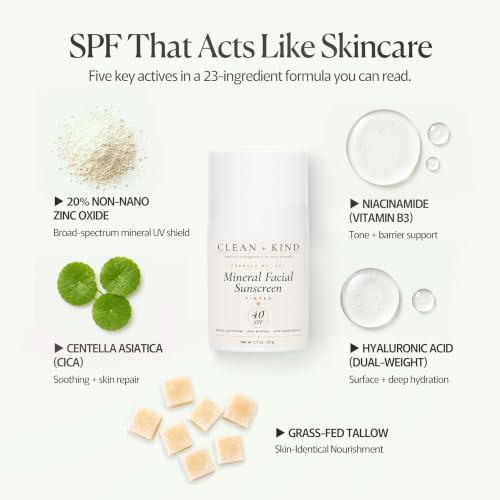
The supplied Amazon title claims SPF 40, iron oxide, and tallow. Those details do not verify the active filters or tint composition.
Check the Drug Facts panel, full ingredients, net quantity, water resistance, and packaging before considering it. Without readable evidence, it is not worth buying on the title alone.
- Label claim
- SPF 40
- Tint claim
- Iron oxide
- Formula claim
- Tallow
- Active percentages
- Not supplied
Application is the real stress test
A sunscreen succeeds only if its labeled amount can form an even, wearable film. Tinted formulas make missed areas easier to spot, but can collect around hair and create visible edges. Untinted formulas avoid pigment transfer, yet repeated passes may intensify a white or gray cast.
Apply without reducing the dose
Use the amount specified on the label. Several thin, even passes can improve distribution, provided the full quantity is applied. Cover the ears, hairline, jaw, and facial-hair area; then inspect in daylight for gaps, clumps, or contrast.
Allow each layer to set before adding makeup. Dry-down times are not standardized, so a fixed waiting period is less useful than observing whether the film still feels wet or shifts with light contact. Pigment or residue transferring at this stage suggests that foundation, brushes, or sponges may disrupt coverage.
For routine outdoor use, the American Academy of Dermatology advises a broad-spectrum, water-resistant SPF 30 or higher. Reapply about every two hours outdoors and after swimming or sweating, following the product’s water-resistance interval. “Water-resistant” does not mean waterproof.
Choose the formula that survives a full application
- Eliminate visible residue first
If an untinted formula leaves an obvious cast after drying, its otherwise strong specifications have limited practical value.
- Check both shade depth and undertone
A tint is viable only when its dry-down looks plausible across the face, hairline, and neck. Shade mismatch is not an improvement over white cast.
- Prioritize pigment when visible light matters
A well-matched formula containing iron oxides may be preferable when visible-light attenuation is a priority. Tint alone does not establish performance.
- Verify claims at a realistic amount
Treat “sheer” and “universal” as unverified until full-application photos and repeated user reports support them.
- Assess reapplication comfort
Favor a film that remains tolerable when reapplied rather than one that pills, transfers heavily, or builds visible pigment.
The practical choice is the formula with an acceptable dry-down at the application amount needed to support labeled protection. It should also remain comfortable enough for regular reapplication. If neither the tint nor the untinted cast meets that standard, neither is worth the money.
