
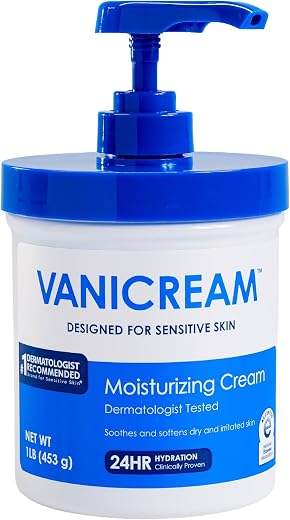
Vanicream seals harder with fewer ingredients. CeraVe adds the lipids that repair your barrier.
The Vanicream vs. CeraVe moisturizer question comes down to what your skin is missing. Both are thick, fragrance-free creams for face and body, and both carry the National Eczema Association seal.
Vanicream is the minimalist. It has about ten ingredients, with petrolatum second on the list, so it locks moisture in hard. There are no dyes, fragrance, lanolin, parabens or botanicals, and it usually costs less per ounce. CeraVe is the repair cream. It uses less petrolatum but adds three ceramides, cholesterol and hyaluronic acid.
So: Vanicream for very dry or highly reactive skin, CeraVe for a damaged barrier or a lighter feel on your face.
Which cream should you buy?

Three differences that matter
Both are thick, fragrance-free face-and-body creams for dry, sensitive skin. Here’s where they split.
-
How much they seal
Vanicream lists petrolatum second; CeraVe lists it seventh. Vanicream locks in more moisture and feels heavier. CeraVe feels lighter, especially on your face.
-
Barrier lipids
CeraVe adds ceramides NP, AP and EOP, cholesterol and phytosphingosine, plus hyaluronic acid. Vanicream has none of these, so CeraVe is the better pick for damaged or eczema-prone skin.
-
Ingredient count
Vanicream has about ten ingredients and no dyes, fragrance, lanolin, parabens or botanicals. CeraVe has twenty-four. If you react to many products, fewer ingredients means fewer suspects.
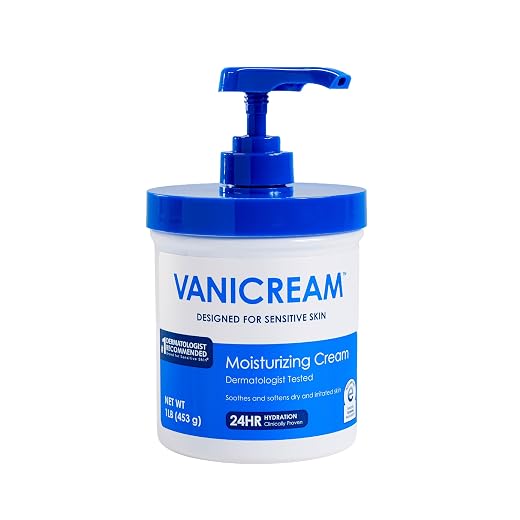
| Stronger seal, shorter list Vanicream Gentle Moisturizing Cream for Sensitive Skin | VS | Barrier repair CeraVe Moisturizing Cream with Ceramides and Hyaluronic Acid |
|---|---|---|
2nd ingredient | Petrolatum |
7th ingredient |
Sorbitol, propylene glycol | Humectants |
Glycerin, hyaluronic acid |
None | Barrier lipids |
Ceramides NP, AP, EOP + cholesterol + phytosphingosine |
About 10 | Ingredient count |
24 |
None | Fragrance |
None |
Yes | National Eczema Association seal |
Yes |
16 oz pump | Container |
19 oz tub |
| View | View |
A moisturizer does up to three jobs: humectants pull water in, occlusives like petrolatum stop it from escaping, and barrier lipids like ceramides help rebuild the layer that holds it.
Vanicream is strongest at the second job: petrolatum is its second ingredient. CeraVe does all three, with less petrolatum but added ceramides, cholesterol and hyaluronic acid. If your skin is dry but intact, Vanicream’s seal is enough. If it’s raw, flaky or stinging, CeraVe’s lipids help more.
Vanicream Moisturizing Cream: a short list and a strong seal
Short-list, petrolatum-rich cream for very dry, reactive skin.
Vanicream’s cream is water, petrolatum, sorbitol, cetearyl alcohol, propylene glycol, ceteareth-20, simethicone, glyceryl stearate, PEG-30 stearate and sorbic acid. Petrolatum, the most effective occlusive in skincare, sits second, so this cream locks moisture in well. Sorbitol and propylene glycol are humectants that draw water into the skin.
It’s free of dyes, fragrance, masking fragrance, lanolin, parabens, botanical extracts and formaldehyde, is labeled non-comedogenic and carries the National Eczema Association Seal of Acceptance. The 16 oz pump keeps fingers out of the cream.
Choose it for very dry, eczema-prone or highly reactive skin, or if you want a big, plain moisturizer for the whole family. Skip it if you know you react to propylene glycol, or if you want ceramides.
- Petrolatum second on the list for a strong moisture seal
- Very short list, with no fragrance, dyes, lanolin, parabens or botanicals
- Hygienic 16 oz pump
- Usually costs less per ounce than CeraVe
- No ceramides, cholesterol or hyaluronic acid
- Heavier feel on the face than CeraVe
- Contains propylene glycol, which a small number of people react to
For very dry or very reactive skin, Vanicream is the better buy. Petrolatum second on the list gives it the stronger seal, the ingredient list is about as short as moisturizers get, and it usually costs less per ounce. If your skin needs barrier repair rather than just protection, CeraVe’s ceramides give it the edge. If eczema keeps flaring despite a simple routine, see a dermatologist.
CeraVe Moisturizing Cream: ceramides for barrier repair
Ceramides, cholesterol and hyaluronic acid for barrier repair.
CeraVe’s cream leads with water, glycerin, fatty alcohols and caprylic/capric triglyceride, a light emollient. Petrolatum comes seventh and dimethicone later still, so it seals less heavily than Vanicream and feels lighter once it settles.
The reason to buy it is the barrier set: ceramides NP, AP and EOP, cholesterol and phytosphingosine, the lipids your skin barrier is made of, plus hyaluronic acid to pull in water. Vanicream has none of these.
It has no fragrance, is labeled not to clog pores and carries the National Eczema Association Seal of Acceptance. Choose it for eczema-prone skin, skin irritated by retinoids or acids, or a face cream that doesn’t feel heavy. Skip it if you want the shortest list possible.
- Three ceramides, cholesterol and phytosphingosine for barrier repair
- Glycerin and hyaluronic acid for hydration
- Less petrolatum, so it feels lighter on the face
- No fragrance; National Eczema Association seal
- Costs more per ounce than Vanicream
- Longer ingredient list with more to react to
- Tub instead of a pump
It is if your skin barrier is damaged, from eczema, over-exfoliating or a retinoid, or if you want something less heavy on your face. It’s the only one of the two with ceramides and cholesterol. If your skin just needs a strong seal and fewer ingredients, Vanicream does that for less per ounce.
The Vanicream vs. CeraVe moisturizer choice is simple once you know what each one is for.
Choose Vanicream Moisturizing Cream if your skin is very dry or reacts to almost everything. Petrolatum is its second ingredient, the list runs to about ten items with no fragrance, dyes, lanolin, parabens or botanicals, it comes in a pump and it usually costs less per ounce.
Choose CeraVe Moisturizing Cream if your barrier needs repair or you want a lighter feel on your face. It adds three ceramides, cholesterol and hyaluronic acid, and its petrolatum sits further down the list.
Both carry the National Eczema Association seal. If you know you react to propylene glycol, choose CeraVe.
