

A tinted sunscreen protects you from the sun. A tinted moisturizer only does if its label says broad-spectrum SPF.
Both add a sheer wash of color, so they look alike in the tube. The difference is the Drug Facts panel. A tinted sunscreen, like CeraVe’s Hydrating Mineral Sunscreen Sheer Tint, has active sunscreen ingredients, an SPF number and directions for how much to use. A tinted moisturizer, like Neutrogena’s Anti-Aging Perfector, may carry a low SPF (this one is SPF 20) or none at all. If it has no SPF on the label, it’s makeup.
So the choice comes down to how many steps you want. If one product is enough, use a tinted sunscreen with broad-spectrum SPF 30 or higher and apply a full layer. If you want more control over coverage, put your sunscreen on first and add a tinted moisturizer on top.
What each product actually is
- Tinted sunscreen
A sunscreen with added pigment, usually iron oxides. In the US it’s an over-the-counter drug, so it carries a Drug Facts label with active ingredients, an SPF number and directions. CeraVe’s Sheer Tint (SPF 30) and EltaMD UV AOX Elements Tinted (SPF 50) are both tinted mineral sunscreens.
- Tinted moisturizer
A moisturizer with pigment for light coverage. Some carry a broad-spectrum SPF and a Drug Facts label, usually a low one: Neutrogena’s Anti-Aging Perfector is SPF 20. If there’s no SPF on the label, count it as makeup.
- Skin tint
A very sheer foundation that evens out tone, often a water-gel with hyaluronic acid. Most skin tints have no SPF, so they always go over sunscreen.
- Broad spectrum
SPF only measures protection from UVB, the rays that cause sunburn. “Broad spectrum” on the label means the sunscreen also passed the FDA’s UVA test. You want both.
What the SPF number covers
SPF measures protection from UVB, the rays behind sunburn. Applied at the tested amount, SPF 30 filters about 97% of UVB and SPF 50 about 98%. SPF 50 isn't twice as strong, and neither number tells you how many hours you can stay outside.
Broad spectrum is a separate claim. It means the sunscreen also protects against UVA, the rays behind tanning and much of the skin aging the sun causes. A high SPF without "broad spectrum" on the label isn't enough.
The amount you apply matters most. SPF is tested at 2 milligrams per square centimeter of skin, roughly a quarter teaspoon for your face. With a tinted product it's easy to use far less, because a full layer can look like too much color. Sheer it out and you get less protection than the label says. Outdoors, reapply at least every two hours.
A product without SPF on its label adds no sun protection, no matter how much you use. That includes skin tints and many tinted moisturizers, even when they contain titanium dioxide for color. Wear it over sunscreen, not instead of it.
If a full layer of tinted sunscreen looks too heavy, don’t use less of it. Switch to an untinted sunscreen at the full amount, then add a thin layer of tint for color. Your sunscreen does the protecting and your tint does the evening out.
What to check before you buy
- Application amount
A tinted sunscreen only gives you its labeled SPF at a full layer, roughly a quarter teaspoon for your face. Try that amount before you commit. If it looks like too much color, you’ll be tempted to use less every day.
Look forA shade that still looks right at a full layer.Watch out forThinning out sunscreen to get the color right. - Coverage and finish
Tinted sunscreens are sheer. Tinted moisturizers and skin tints are easier to build where you want more coverage. Dewy finishes can look shiny on oily skin, and matte ones can catch on dry patches.
Look forA finish that suits your skin type.Watch out forAssuming more coverage means more protection. - Shade and iron oxides
Iron oxides give tinted products their color and also help block visible light, which matters if you have melasma or dark spots that keep coming back. All three products here contain them. If you’re managing melasma, see a dermatologist about the best routine for you.
Look forIron oxides in the ingredient list if dark spots are a concern.Watch out forAssuming every tinted product contains them. - Reapplication
Outdoors, reapply at least every two hours, and after swimming or sweating. CeraVe’s tint isn’t water resistant, so switch to a water-resistant sunscreen for the pool or a workout.
Look forA product you'll realistically reapply.Watch out forRelying on one morning layer for a full day outside.
Tinted sunscreen: CeraVe Hydrating Mineral Sunscreen Sheer Tint
CeraVe's tinted sunscreen uses 10% zinc oxide and 5.5% titanium dioxide for broad-spectrum SPF 30. Iron oxides give it a sheer tint that offsets the white cast mineral filters can leave. The version linked here is Medium, and a Deep shade is also available.
The base is moisturizing. It has the three ceramides (NP, AP, EOP), cholesterol, niacinamide and hyaluronic acid found across CeraVe's line, in a lotion with plenty of emollients, and it's fragrance-free. That makes it a good fit for normal to dry skin, and for sensitive skin that does better with mineral filters.
It isn't water resistant, and it comes in a 1.7 oz tube. On oily skin the emollient base can look shiny by afternoon. If the shade sits close to your skin at a full layer, it can replace both your sunscreen and a separate tint.

The simplest one-step choice here. Broad-spectrum SPF 30 from 10% zinc oxide and 5.5% titanium dioxide, a sheer iron-oxide tint, and ceramides, niacinamide and hyaluronic acid in a fragrance-free lotion.
Best for normal, dry or sensitive skin that wants light coverage. Skip it if you’re very oily or need a water-resistant sunscreen.
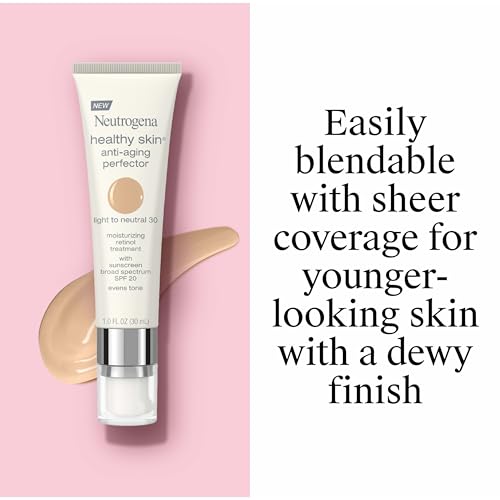
Tinted moisturizer: Neutrogena Anti-Aging Perfector
The Anti-Aging Perfector is a classic tinted moisturizer. Its sunscreen actives are octinoxate 7% and octisalate 3%, labeled Broad Spectrum SPF 20. Titanium dioxide and iron oxides give it a sheer tint, and the formula adds a little retinol and retinyl palmitate, vitamin E and olive fruit extract in a silicone-smoothed base.
SPF 20 isn’t enough on its own. The American Academy of Dermatology recommends SPF 30 or higher, and a tinted moisturizer is almost never applied thickly enough to reach its labeled number. Put a full layer of sunscreen on first, let it set for a few minutes, then add the Perfector for color and smoothing.
It contains fragrance and comes in a 1 fl oz tube. It suits normal to dry skin. Skip it if fragrance bothers you or if you already use a retinoid at night and don’t want more in the morning.
A sheer tinted moisturizer with a little retinol, labeled Broad Spectrum SPF 20. Good for evening out tone on normal to dry skin.
SPF 20 is below the SPF 30 minimum dermatologists recommend, so wear it over a full layer of sunscreen.
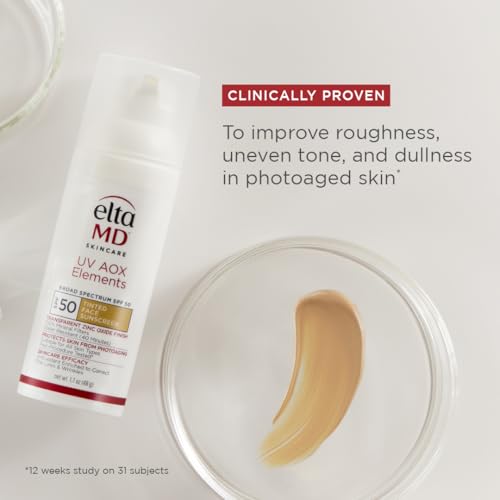
Higher-SPF tinted sunscreen: EltaMD UV AOX Elements Tinted
EltaMD UV AOX Elements Tinted uses 13.5% zinc oxide and 4.4% titanium dioxide for broad-spectrum SPF 50. At a full layer, that blocks about 98% of UVB against CeraVe's 97%. The gain is real but small, so pick it for the formula as much as the number.
The base is built on silicones rather than CeraVe's rich lotion. Dimethicone and related silicones give it a smooth, slippy feel, and iron oxides provide the tint. It also adds hyaluronic acid, vitamin E, a vitamin C derivative (ascorbyl palmitate), bisabolol and ginger root extract.
It costs several times more per ounce than CeraVe. That's worth it if you want SPF 50, prefer a silky silicone finish, or have combination skin that finds CeraVe too rich. It isn't worth it if you'll ration it to make the tube last. A cheaper sunscreen used generously protects you better.
The higher-SPF tinted option. Broad-spectrum SPF 50 from 13.5% zinc oxide and 4.4% titanium dioxide, in a silky silicone base with iron oxides and antioxidants.
Choose it for SPF 50 and a smoother finish on normal to combination skin. Skip it if the cost will make you apply it sparingly.
Which routine should you use?
Pick the routine that gets a full layer of sunscreen on your face every day. Everything else is about how it looks.
- One step: tinted sunscreen. Use CeraVe's Sheer Tint for an affordable SPF 30 with a moisturizing base, or EltaMD UV AOX Elements Tinted for SPF 50 in a silkier formula. Apply a full layer and you're done.
- Two steps: sunscreen, then tinted moisturizer. Apply any broad-spectrum SPF 30 or higher at the full amount, then add a tinted moisturizer such as Neutrogena’s Anti-Aging Perfector where you want coverage. This is the better route if tinted sunscreens never match your skin.
- A tinted moisturizer with SPF. Count it as sunscreen only if the label says broad spectrum and you apply the full amount. Otherwise, wear sunscreen underneath.
Check the Drug Facts panel, not the product name. A tinted moisturizer with broad-spectrum SPF 30 on its label works as sunscreen if you use enough of it. One without that label doesn't, however much you apply.
Reapply when you're outside. Do it every two hours, and after swimming or sweating. Over makeup, a tinted sunscreen is easier to reapply than an untinted one because it blends in with the color already on your face.
Check the label, then the look
-
Find broad-spectrum SPF 30 or higher
It has to be on the label. Color alone doesn’t count, and neither does a mineral that’s only there for tint.
-
Use the full amount
Roughly a quarter teaspoon for your face. That’s the amount the SPF number is based on.
-
Judge the shade at that amount
A tint that looks fine as a dab can look heavy at a full layer. Test it along your jaw in daylight.
-
Match the finish to your skin
Emollient formulas like CeraVe’s suit dry skin. Silicone formulas like EltaMD’s suit normal to combination skin.
-
Weigh cost against how much you'll use
An expensive sunscreen you ration protects you less than an affordable one you apply generously.
Choose a tinted sunscreen if you want one step. CeraVe’s Sheer Tint is the affordable SPF 30 pick for normal, dry or sensitive skin. EltaMD UV AOX Elements Tinted is the SPF 50 pick in a silkier base, at a much higher cost.
Choose a tinted moisturizer if you want more control over coverage, and wear it over sunscreen unless its own label says broad-spectrum SPF. Neutrogena’s Anti-Aging Perfector is labeled Broad Spectrum SPF 20, which helps but falls short of the SPF 30 dermatologists recommend, so wear it over sunscreen too.
Whichever you pick, apply a full layer and reapply every two hours outdoors.
