
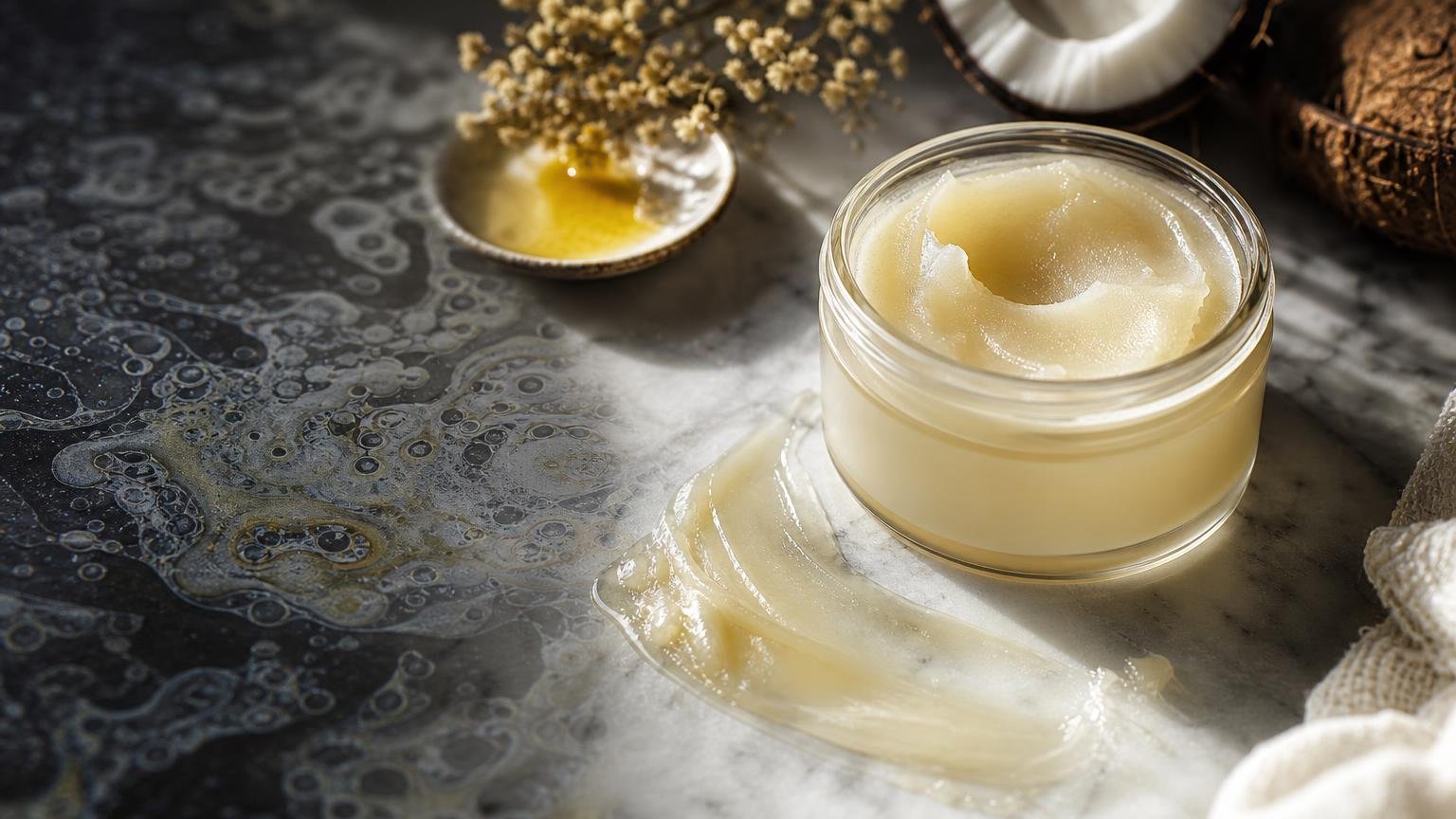
A greasy film means the balm didn't fully emulsify before you rinsed.
A cleansing balm greasy film almost always comes from one of three things: too much balm, too little water worked in before rinsing, or a formula with more oil and wax than its emulsifier can handle. The first two are fixable tonight. The third means switching balms.
A balm is oils and waxes plus an emulsifier. The oils dissolve makeup and sunscreen. The emulsifier is what lets that oil mix with water and rinse away. When you add water and massage, a good balm turns milky white. If yours stays clear and slick, it hasn’t emulsified, and whatever doesn’t emulsify stays on your face.
Don’t scrub harder. Use a smaller amount on dry skin, add water a little at a time until it turns milky, and rinse with lukewarm water. If your skin is still slick after three tries like that, the formula is the issue.
How to make a balm turn milky
- Apply to dry skin with dry hands
Massage for 30 to 60 seconds. The oils need contact time to dissolve sunscreen, makeup and sebum. Water at this stage stops the balm spreading.
- Wet your fingertips, not your face
Add a small amount of lukewarm water. A big splash washes around the oil instead of mixing into it.
- Massage until it turns white
The emulsifier grabs oil on one end and water on the other. Working it in turns the clear oil into a thin, milky lotion. That change is what lets it rinse.
- Repeat two or three times
Add a little more water each time. The mix should get whiter and less slippery with each round.
- Rinse thoroughly and check
Rinse with lukewarm water and pat dry. If your skin is still slick, you used too much balm or the formula doesn’t emulsify well. Don’t scrub it off.
Water alone can’t rinse oil. The balm has to turn milky first.
If the balm stays clear and oily no matter how slowly you add water, technique isn’t the issue. The formula doesn’t have enough emulsifier for its oil load. More massage won’t change that, so swap it for a balm that turns white with water.
Too much balm leaves more film
If the film gets worse the more balm you use, you're using too much. Each scoop carries a fixed amount of emulsifier. Pile on more and the extra oil has nothing to carry it off.
This happens most when you use a full scoop for a light job, like everyday sunscreen or a morning cleanse. A fingertip-sized amount covers a whole face.
Change one thing at a time:
- Cut your usual scoop by about a quarter.
- Keep everything else the same: massage time, water temperature, rinse.
- Add water gradually, rinse, then check your towel.
- Cut back again only if makeup still comes off fully and the film is still there.
Hotter water won't fix it. It makes the balm feel runnier but doesn't add emulsifier, and it dries your skin. If a small dose still leaves a clear, oily layer, the formula is too oil-heavy for you.
Slick patches mean a missed rinse
If your cheeks and forehead feel clean but your hairline, nose, jaw or chin stay slick, the balm is fine. Water just isn't reaching those spots. Splashing tends to miss the contours of your face.
Rinse in sections with lukewarm water:
- Cup water in your hands and press it onto each area instead of splashing.
- Turn your head to each side to reach the jaw and hairline.
- Run a clean fingertip along the sides of your nose and your chin. If it slides, rinse that spot again.
For a stubborn edge, press a soft, damp cloth on it and lift once. Don't rub back and forth. Use a fresh cloth, since one washed with fabric softener can leave its own slip.
If wiping leaves your skin warm or pink, stop. The cloth is irritating your skin, not removing more oil.
When the formula is the problem
If you used a small dose, massaged it in, turned it milky and rinsed carefully, and your whole face is still slick, the formula is the cause. It has more oil and wax than its emulsifier can carry away.
What creates the afterfeel
Oils and esters, like ethylhexyl palmitate and caprylic/capric triglyceride, dissolve makeup and give slip. Waxes and butters, like polyethylene, synthetic wax and shea butter, make the balm solid in the jar. The more of these a formula carries relative to its emulsifier, the more is left behind when you rinse.
Some balms are built to leave a soft, conditioned layer on purpose. That's fine if you like it. It's the wrong choice if you want skin that feels bare after rinsing, and "nourishing" on the jar usually signals more of that layer, not less.
What the ingredient list can reveal
Ingredients are listed from most to least down to 1%, so the top of the list tells you what the balm is mostly made of. Below 1%, order is free.
Look for an emulsifier in the top five or six ingredients: sorbeth-30 tetraoleate, PEG-20 glyceryl triisostearate, PEG-5 glyceryl triisostearate, PEG-10 isostearate or polysorbates. Clinique Take The Day Off lists sorbeth-30 tetraoleate fourth. e.l.f. Holy Hydration and Farmacy Green Clean list PEG-20 glyceryl triisostearate in the top four. A balm with oils and butters up top and no emulsifier until far down the list will rinse poorly.
If you've fixed the dose, the water and the rinse and the film is still there, stop adjusting your routine and change the balm. Hotter water and a stronger second cleanser only add dryness.
When the film changes with your water
If the same balm rinses clean at a friend's place but not at home, look at your water. Hard water carries calcium and magnesium, which make some cleansing ingredients less effective. That can leave more oil behind.
Temperature matters too. Cold water keeps waxes like polyethylene firm, so they cling instead of rinsing. Very hot water dries your skin and makes any film feel worse. Lukewarm is the right setting.
To test it:
- Use the same dose each time, about the size of a fingertip.
- Keep massage and emulsifying time the same.
- Use lukewarm water both times.
- Rinse once with tap water, and once with a final splash of distilled or filtered water.
- Let your skin dry for a minute, then check for slip or towel transfer.
If the softened-water rinse comes out clearly cleaner, your tap water is part of the problem. A final rinse with filtered water, or a balm that rinses well in your water, solves it. Most people don't want to keep a jug of distilled water by the sink, so switching balms is usually the easier fix.
A second cleanse should not rescue the balm
Double cleansing is useful after water-resistant sunscreen, long-wear foundation or heavy eye makeup. The balm dissolves them, and a mild water-based cleanser picks up the last traces. Keep the second step short and gentle.
Using a strong foaming wash to strip off a balm that won't rinse is a different thing. It hides the problem, costs you an extra product, and leaves your skin drier than either cleanser would alone.
A second cleanse makes sense when:
- The balm turns milky and rinses mostly clean on its own.
- You wore long-wear makeup or water-resistant sunscreen.
- One quick pass of a mild cleanser leaves your skin comfortable.
If you need a second cleanse every night just to feel clean, even on light-makeup days, the balm isn't doing its job. A good balm should leave you needing the second step only after heavy makeup or water-resistant sunscreen.
A second cleanse should take off traces, not a whole layer of oil. If you need a foaming cleanser every night just to get the balm off, and your skin feels tight afterward, the balm is the wrong one. Replace it.
Is it residue or a skin reaction?
Is a slippery finish a sign of irritation?
No. Slip with no stinging, itching or redness is leftover oil. It washes off with your next cleanse. Burning, itching or redness is a reaction, not residue.
What should I do if the balm burns or itches?
Rinse it off with lukewarm water and stop using it. Don’t follow with scrubs, acids or a strong cleanser. That makes the reaction worse and harder to trace.
Can fragrance or essential oils cause the problem?
They can cause stinging, but not a film. Many balms contain citrus, lavender or ylang-ylang oils, which are common irritants. If your skin reacts, pick a fragrance-free balm such as Clinique Take The Day Off or CeraVe’s cleansing balm.
Are botanical balms gentler?
No. Plant oils and extracts are not milder by default, and essential oils are among the more common triggers. A short list without essential oils is the safer bet for reactive skin.
Can leftover balm cause bumps?
It can for some people, especially around the hairline and jaw where rinsing is weakest. Stop the balm for two weeks and change nothing else. If the bumps clear, it was the balm. If they persist, see a dermatologist.
For the full two-step routine, see how to double cleanse. If you are still choosing a format, cleansing balm vs. cleansing oil compares how each one rinses.
Fix the method first, then judge the balm
- Give it three cleanses with the same small dose: dry skin, wet fingertips, massage until milky, rinse with lukewarm water.
- If it still leaves a film, switch to a balm with a named emulsifier high in the list, such as sorbeth-30 tetraoleate or PEG-20 glyceryl triisostearate.
A cleansing balm greasy film almost always means the balm never fully turned milky before you rinsed. Use less, add water a little at a time, and massage until the oil turns white. That fixes most cases in one or two washes.
If a fingertip-sized dose still leaves your face slick or marks a clean towel after three careful tries, the formula is the problem. Replace it with one that emulsifies fully rather than adding a harsher second cleanser to scrub it off.
