
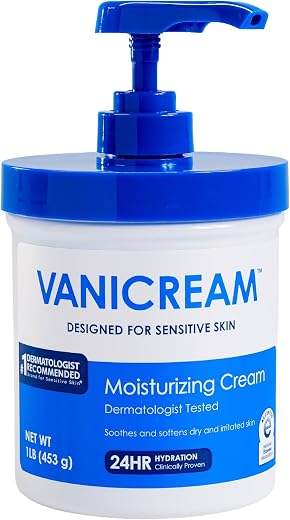
Vanicream is the rich, plain cream for dry skin. Toleriane is the lighter face moisturizer with niacinamide.
Vanicream Moisturizing Cream is a short, petrolatum-based formula in a 16 oz pump, made for face and body. It has no fragrance, lanolin or botanicals, and it’s heavy enough for very dry or eczema-prone skin. La Roche-Posay Toleriane Double Repair is a face-only cream built on glycerin and dimethicone, with niacinamide and ceramide NP. It absorbs fast and sits well under sunscreen.
If your skin is very dry or reacts to everything, start with Vanicream. If you want a light daytime face moisturizer, choose Toleriane. Vanicream also makes a lighter Daily Facial Moisturizer with five ceramides, covered below, if you want to stay with Vanicream on your face.
Which moisturizer fits your skin?
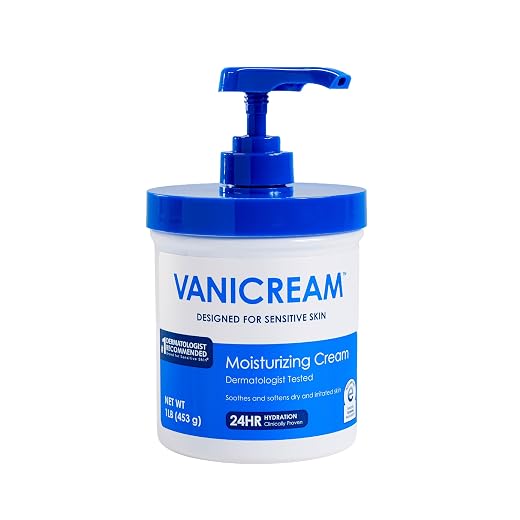

| Rich face-and-body cream Vanicream Moisturizing Cream for Face and Body | VS | Light daytime face cream La Roche-Posay Toleriane Double Repair Face Moisturizer |
|---|---|---|
Rich, slightly greasy | Texture |
Light, absorbs quickly |
Petrolatum, sorbitol | Key ingredients |
Glycerin, dimethicone, niacinamide, ceramide NP |
None | Ceramides |
Ceramide NP |
No | Niacinamide |
Yes |
Face and body | Use |
Face only |
Very dry, sensitive, eczema-prone | Best skin type |
Normal, combination, oily |
Much lower | Cost per ounce |
Much higher |
| View | View |
What the ingredients actually do
All three moisturizers do the same three jobs in different proportions. Humectants pull water into the skin: sorbitol in the Vanicream cream, glycerin in Toleriane and the Vanicream facial. Emollients smooth and soften: squalane in the Vanicream facial, hydrogenated polyisobutene in Toleriane. Occlusives slow water loss: petrolatum in the Vanicream cream, dimethicone in Toleriane. Petrolatum is the heavier of the two, which is why the Vanicream cream feels richer.
Vanicream Moisturizing Cream has no ceramides at all. The ceramides belong to Vanicream Daily Facial Moisturizer, which lists five, and to Toleriane, which lists ceramide NP. Toleriane is the only one of the three with niacinamide.
Niacinamide is the main thing Toleriane has that the Vanicream cream doesn’t. It supports the barrier and can calm redness over time, which helps if your skin runs red or uneven. If your only goal is to stop dryness, the Vanicream cream does that job with fewer ingredients and for less per ounce.
Vanicream Moisturizing Cream: a plain, rich cream for face and body
16 oz pump of fragrance-free, petrolatum-based cream.
Vanicream’s cream is water, petrolatum and sorbitol (a humectant), followed by cetearyl alcohol, a non-drying fatty alcohol, propylene glycol and a few emulsifiers. Petrolatum does the heavy lifting: it sits on the skin and slows water loss, which is what very dry, rough or eczema-prone skin needs. It carries the National Eczema Association Seal of Acceptance.
What’s missing matters as much. There’s no fragrance, dye, lanolin, parabens or botanical extracts, which makes it one of the safest choices for skin that reacts to almost everything. It also has no ceramides or niacinamide, so it’s a straight moisturizer rather than a treatment.
The 16 oz pump is meant for face and body. On the face it’s rich, so it works best at night or on dry skin.
- Short formula with no fragrance, lanolin, dyes or botanicals
- Petrolatum seals in moisture on very dry skin
- 16 oz pump covers face and body
- Costs far less per ounce than Toleriane
- Heavy under sunscreen or makeup
- No ceramides or niacinamide
- Contains propylene glycol, which a small number of people react to
Toleriane Double Repair: a light face cream with niacinamide
Light face cream with niacinamide and ceramide NP.
Toleriane Double Repair is built for the face. La Roche-Posay’s thermal spring water comes first, then glycerin, a humectant that draws water into the skin, and dimethicone, a silicone that smooths and slows water loss without a greasy feel. Niacinamide (vitamin B3) is fifth on the list; it supports the skin barrier and can calm redness with regular use. Ceramide NP adds one of the lipids your barrier is made of.
The texture is a light cream that absorbs quickly, so it works under sunscreen and makeup. It’s fragrance-free, oil-free and labeled non-comedogenic, which makes it an easy pick for combination and oily skin as well as normal skin.
It’s a face-only product in a small bottle, so per ounce it costs much more than the Vanicream cream.
- Niacinamide and ceramide NP in a light cream
- Absorbs quickly and layers well under sunscreen
- Fragrance-free, oil-free and labeled non-comedogenic
- Face only, in a small bottle
- Costs much more per ounce than the Vanicream cream
- Not rich enough on its own for very dry skin
Vanicream Daily Facial Moisturizer: the lighter Vanicream

Light 3 fl oz lotion with five ceramides.
This is a separate formula, not a smaller version of the cream. Squalane, a lightweight emollient, comes second, followed by glycerin. Further down are hyaluronic acid and five ceramides (EOP, NG, NP, AS and AP), plus phytosterols and carnosine. The result is a light lotion that absorbs quickly and sits well under sunscreen and makeup.
Like the cream, it has no fragrance, dyes, essential oils or botanical extracts, and it’s labeled non-comedogenic. It has no niacinamide, which makes it the simpler choice if niacinamide has bothered your skin before.
It comes in a 3 fl oz bottle and is for the face only.
- Five ceramides plus hyaluronic acid
- Squalane gives a light, non-greasy feel
- No fragrance, essential oils or botanical extracts
- Labeled non-comedogenic
- Small 3 fl oz bottle
- No niacinamide
- Seals in less than the Vanicream cream
How texture changes the choice
Vanicream Moisturizing Cream is thick. Petrolatum is the second ingredient, so it leaves a soft, slightly greasy layer. That's ideal on dry legs, hands and winter cheeks, but it can feel heavy under sunscreen or makeup, and on oily or combination skin it's usually too much for the face.
For daytime, the facial formulas are the better fit. Toleriane relies on glycerin, dimethicone and a light emollient, so it absorbs fast and layers well under sunscreen and makeup. Vanicream Daily Facial Moisturizer uses squalane, glycerin and hyaluronic acid for a similar lightweight lotion. Choose Toleriane if you want niacinamide. Choose the Vanicream facial if you'd rather have more ceramides and no niacinamide.
A practical split works for a lot of people: the Vanicream cream on your body and on very dry patches, plus one of the facial formulas on your face in the morning. If your face is dry enough to want a rich cream, skip the facial moisturizer and use the Vanicream cream everywhere.
Choose Vanicream Moisturizing Cream if your skin is very dry or easily irritated, or you want one moisturizer for face and body. It’s a short, petrolatum-based formula with no fragrance, lanolin or botanicals, and the 16 oz pump costs far less per ounce.
Choose La Roche-Posay Toleriane Double Repair if you want a light face moisturizer that sits well under sunscreen. Glycerin, dimethicone, niacinamide and ceramide NP make it the better fit for normal, combination and oily skin.
If the Vanicream cream feels too heavy on your face but you want to stay with Vanicream, its Daily Facial Moisturizer is the lighter option, with squalane, hyaluronic acid and five ceramides.
